
EDOF Lens
Extended depth of focus intraocular lens · Prof. Dr. Fırat Helvacıoğlu, FEBOS-CR · Veni Vidi Eye Clinic, Caddebostan – Kadıköy, Istanbul
An EDOF lens is a smart intraocular lens that provides a continuous range of clear vision from distance to intermediate. It offers spectacle-free vision for distance and intermediate tasks such as driving and computer work. However, for very close reading, you may sometimes need thin reading glasses. The surgeon implants it during cataract or smart lens surgery, and a toric model is also available for astigmatism.
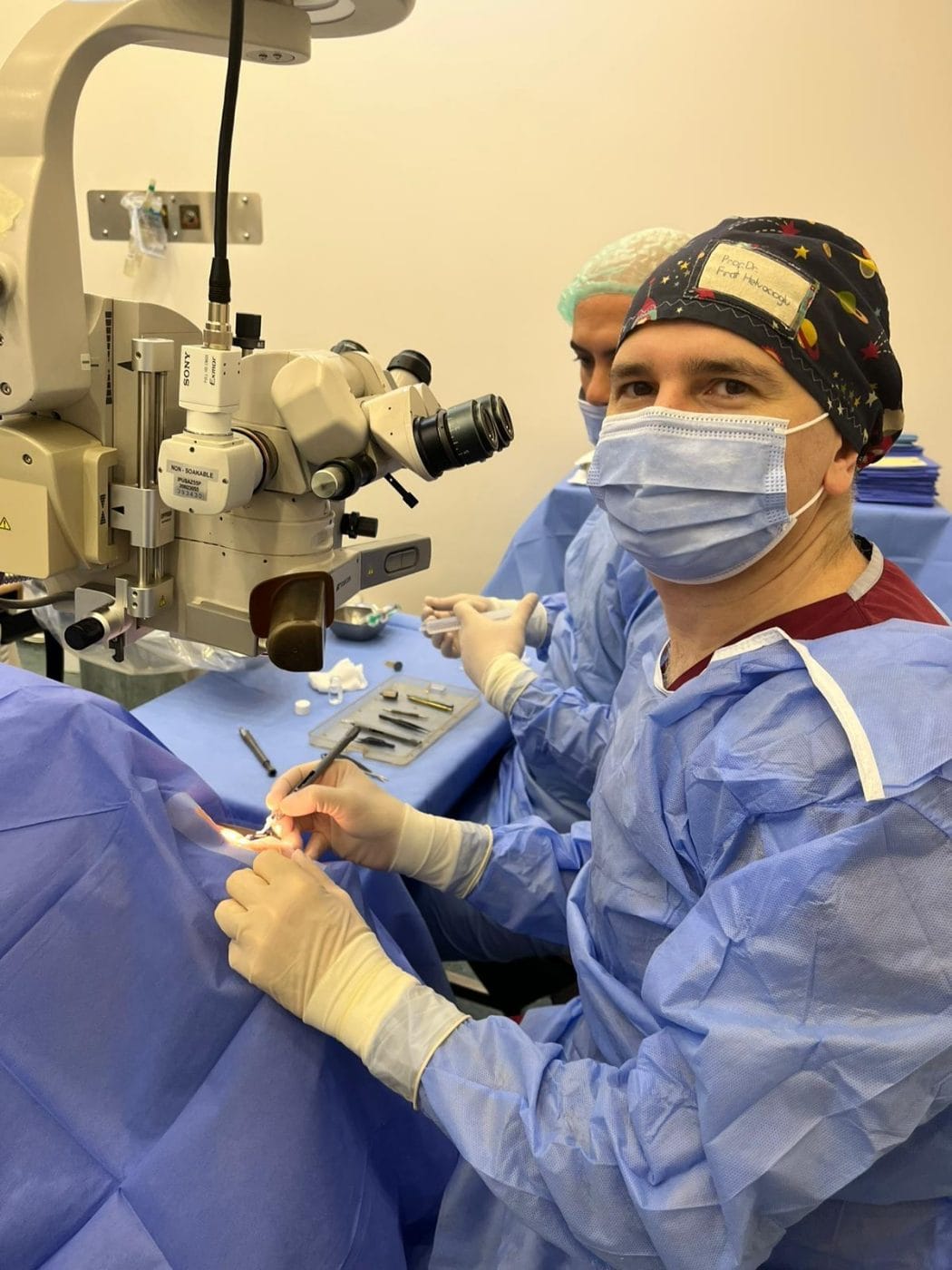
What is an EDOF lens?
An EDOF (extended depth of focus) lens is a smart intraocular lens that, instead of focusing light at a single point, creates a continuous range of clear vision extending from distance to intermediate. It replaces the natural lens during cataract surgery or during smart lens surgery performed for presbyopia.
Whereas trifocal lenses split light into three separate foci (distance, intermediate and near), EDOF lenses elongate the focal point, providing spectacle-free vision particularly at distance and intermediate ranges (driving, computer work, the dining table). EDOF lenses come in diffractive and non-diffractive (wavefront-shaping) designs, and your eye measurements determine the appropriate design.
Which distances can you see clearly?
The strength of this lens lies in the range extending from distance to arm’s length. Vision at very close distances, such as a book or phone, varies from person to person; some patients may need thin reading glasses for prolonged reading.
EDOF or trifocal?
| Feature | EDOF lens | Trifocal lens | Monofocal lens |
|---|---|---|---|
| Distance | Very good | Very good | Very good |
| Intermediate (computer) | Very good | Very good | Glasses usually needed |
| Near (reading) | Moderate; reading glasses sometimes needed | Very good | Reading glasses needed |
| Night-time halos | Possible | Possible; more noticeable in the first months | Rare |
According to a Cochrane review comparing trifocal and EDOF lenses, distance vision is similar with both lens types, while trifocal lenses perform better for near vision. A meta-analysis of 22 studies including 2,200 eyes likewise found no significant difference in intermediate vision, with better near vision and spectacle independence for trifocal lenses. The studies also found no significant difference in halos and glare between the two lens types. In short, there is no single “best lens”; we choose the lens according to your visual expectations.
Who is an EDOF lens suitable for?
- People who prioritise distance and intermediate vision: Those who drive a lot, work at a computer all day and want to manage short near tasks without glasses.
- People who value night-time visual quality: We may consider this lens for patients who feel they are sensitive to halos or who drive frequently at night.
- Some eyes unsuitable for a trifocal lens: In some patients, mild ocular conditions mean that we do not recommend a trifocal lens; an EDOF lens may then be an option following the surgeon’s assessment.
- Patients with astigmatism: The toric model of the EDOF lens also corrects astigmatism in the same operation (toric lens).
For patients who want the highest level of spectacle independence at near as well, however, a trifocal lens is usually more suitable.
Mini-monovision: enhancing near vision with an EDOF lens
To enhance near vision with EDOF lenses, we can use a mini-monovision approach: we set the dominant eye for distance and the other eye slightly for near. With both eyes working together, distance vision stays intact while near vision becomes stronger. In a study with a non-diffractive EDOF lens, the spectacle independence rate was 89.2% in patients with mini-monovision, compared with 70.4% in patients with both eyes targeted for distance. We decide at the consultation whether this approach is right for you, taking into account your ocular dominance and expectations.
How does EDOF lens surgery work?
An EDOF lens replaces the natural lens during cataract or smart lens surgery. The operation takes place under topical anaesthesia, usually lasts 10–15 minutes per eye, and the patient goes home the same day. In most patients vision clears markedly within the first few days; full adaptation of the brain to the new lens may take a few weeks.
More information: Cataract surgery · Smart lens surgery · Refractive lens exchange
Cost and information for international patients
We finalise the cost of EDOF lens surgery after the examination. It depends on the lens model, whether you need a toric lens, and whether we treat one or both eyes.
For international patients: Send us your previous eye reports by WhatsApp to receive a personalised treatment plan and quote. For surgery on both eyes, we recommend planning a stay of about one week in Istanbul. Consultations are available in English.
Frequently asked questions
An EDOF lens provides a continuous range of clear vision from distance to intermediate, whereas a trifocal lens splits light into three foci: distance, intermediate and near. Distance vision is similar with both; however, trifocal lenses perform better for near vision.
Many patients can manage everyday near tasks without glasses, but they may need thin reading glasses for very small print or prolonged reading. Mini-monovision can reduce this need.
You may notice halos or glare around lights at night, particularly in the first months; these usually diminish over time. Comparative studies have not shown a significant difference between EDOF and trifocal lenses in this respect.
Yes. Its toric model can also correct astigmatism in the same operation.
Yes. Intraocular lenses are permanent and do not deteriorate. In the rare event that it becomes necessary, the surgeon can exchange the lens.
Yes. After reviewing your eye reports sent via WhatsApp, we prepare a treatment plan. We can usually complete surgery on both eyes within about one week, and follow-up can then continue with your own ophthalmologist.
References
- Tavassoli S et al. Trifocal versus extended depth of focus (EDOF) intraocular lenses after cataract extraction. Cochrane Database Syst Rev. 2024;7(7):CD014891. doi:10.1002/14651858.CD014891.pub2
- Karam M et al. Extended depth of focus versus trifocal for intraocular lens implantation: an updated systematic review and meta-analysis. Am J Ophthalmol. 2023;251:52–70. doi:10.1016/j.ajo.2023.01.024
- Chao CC et al. Visual outcomes and reading performance of a non-diffractive EDOF IOL: a prospective comparison of emmetropia and mini-monovision targets. Clin Ophthalmol. 2026;20:590555. doi:10.2147/OPTH.S590555
- Huang Y et al. Clinical outcomes and visual quality after implantation of extended depth of focus intraocular lenses with mini-monovision design. BMC Ophthalmol. 2025;26(1):52. doi:10.1186/s12886-025-04588-6
- Alvarado-Villacorta R et al. Surgical interventions for presbyopia. Cochrane Database Syst Rev. 2025;4(4):CD015711. doi:10.1002/14651858.CD015711.pub2
- Tunç Z, Helvacıoğlu F, Şencan S, Şimşek S. Accommodative IOL Implantation in Cataract Surgery. Turkish Journal of Ophthalmology. 2012;42(4):257-262. doi:10.4274/tjo.42.47965
- Tunç Z, Helvacıoğlu F, Şencan S, Şimşek Ş. Multifokal Progressif Refraktif Difraktif Lens: Optik Tasarım ve Klinik Sonuçları. Türk Oftalmoloji Dergisi. 2012;42(5):326-331. doi:10.4274/tjo.42.44366
This page provides information for patients and does not replace an examination or medical assessment. Your doctor determines the treatment that is right for you after an eye examination and measurements.
Book an EDOF lens suitability assessment
Prof. Dr. Fırat Helvacıoğlu · Veni Vidi Eye Clinic, Bağdat Caddesi No: 257, Caddebostan – Kadıköy, Istanbul, Türkiye