
Presbyopia (Age-Related Near Vision Loss) Treatment
Age-related loss of near vision · Prof. Dr. Fırat Helvacıoğlu, FEBOS-CR · Veni Vidi Eye Clinic, Caddebostan – Kadıköy, Istanbul
Presbyopia is the increasing difficulty in seeing up close from the 40s onwards as the eye’s lens loses its flexibility. Reading or progressive glasses and multifocal contact lenses are part of presbyopia treatment. In suitable people, laser monovision offers a permanent solution, and so does refractive lens exchange with a trifocal or EDOF smart lens over 45.
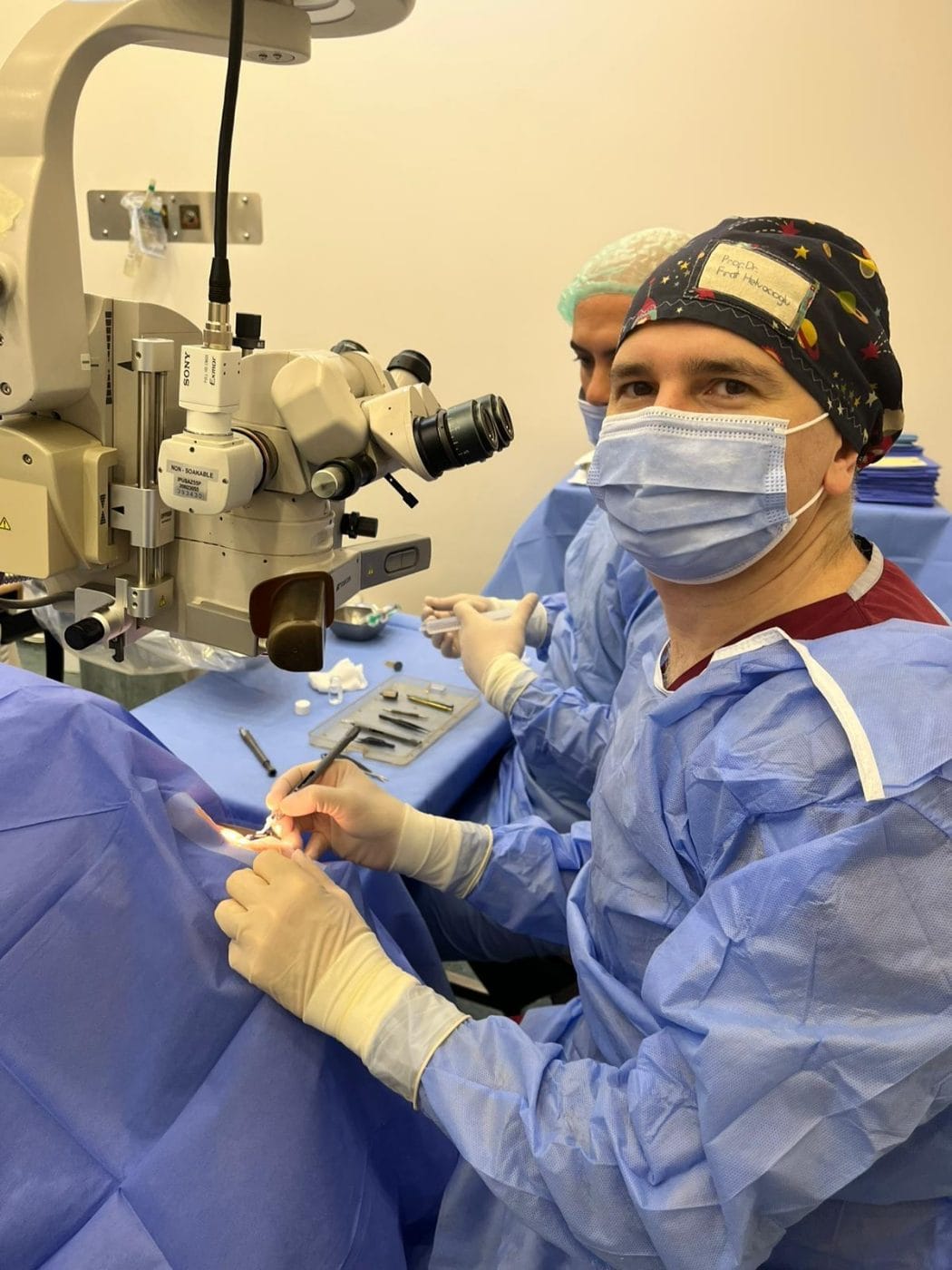
What is presbyopia (age-related near vision loss)?
Presbyopia is the reduced ability to focus at near caused by the age-related loss of flexibility of the eye’s lens. People usually notice it around the ages of 40–45. For example, typical signs are holding the phone or book further away to read, finding small print hard to see in dim light and eye strain during near work. It is not a disease but an age-related change that happens to everyone, and it progresses until the 60s.
Presbyopia is one of the most common vision problems in the world. According to a meta-analysis, about 1.8 billion people had presbyopia in 2015, and nearly half of them did not have adequately corrected near vision.
Presbyopia treatment options
| Option | Description |
|---|---|
| Reading glasses | The simplest solution; used only for near |
| Progressive (multifocal) glasses | Distance, intermediate and near in a single lens; may require a period of adaptation |
| Multifocal contact lenses / monovision | Multifocal lenses, or setting one eye for distance and the other for near |
| Laser monovision / corneal modulation | In suitable patients, the surgeon sets one eye for distance and the other slightly for near, or shapes the cornea to be multifocal. This can be considered particularly for people in their 40s whose natural lens is still clear |
| Smart lens / refractive lens exchange | The surgeon removes the natural lens and implants a trifocal lens or EDOF lens. In this way, the lens targets distance, intermediate and near vision together, and a cataract will not develop in the future |
A Cochrane review of surgical presbyopia treatment emphasises that different methods can increase spectacle independence. However, each has its own trade-offs, such as night-time halos and reduced contrast. Meta-analyses comparing trifocal and EDOF lenses have found better near vision and spectacle independence with trifocal lenses.
For contact lens wear, the doctor determines the suitable lens type and power at the examination. You then obtain the lens according to this recommendation. The doctor also monitors lens fit and corneal health at regular check-ups.
Which presbyopia treatment suits whom?
- Age 40–50, clear natural lens, good distance vision without glasses: Reading glasses or multifocal contact lenses are often sufficient, and the doctor may consider laser monovision in suitable patients.
- People who wear glasses for both distance and near (myopia, hyperopia, astigmatism + presbyopia): Over 45, refractive lens exchange with a smart lens is a frequent choice, and results are particularly satisfying in high hyperopia.
- People with early cataract: Presbyopia is also treated by implanting a smart lens during cataract surgery.
- Frequent night drivers and people sensitive to halos: An EDOF lens or monovision planning is discussed.
Prof. Dr. Fırat Helvacıoğlu’s research on presbyopia
Research
Prof. Dr. Fırat Helvacıoğlu and his team presented the long-term results of corneal modulation — simultaneous excimer laser correction of presbyopia together with myopia, hyperopia or astigmatism — at the 34th ESCRS Congress (Copenhagen, 2016). His smart lens research includes trifocal lens outcomes, topographic factors leading to dissatisfaction after trifocal lens implantation and a comparison of bifocal and trifocal lens performance (ESCRS 2017–2019). He is also a co-author of a published study on supraciliary contraction segments developed for presbyopia (Indian J Ophthalmol, 2014), which reported that the early improvement with this method regressed by 18 months.
Frequently asked questions
People usually notice it around the ages of 40–45, and it progresses slowly until the 60s.
Yes. Because myopic people can see near objects by taking off their glasses, they may notice it later. However, presbyopia develops in everyone.
In suitable patients, doctors can perform laser monovision or corneal modulation. For people over 45 who wear glasses for both distance and near, refractive lens exchange with a smart lens is often a more lasting presbyopia treatment.
No. Reading glasses do not accelerate presbyopia; they simply allow you to see comfortably at near.
Because the smart lens replaces the natural lens, its effect is permanent and a cataract will not develop in the future. Therefore, detailed measurements determine suitability.
References
- Fricke TR et al. Global prevalence of presbyopia and vision impairment from uncorrected presbyopia: systematic review, meta-analysis, and modelling. Ophthalmology. 2018;125(10):1492–1499. doi:10.1016/j.ophtha.2018.04.013
- Alvarado-Villacorta R et al. Surgical interventions for presbyopia. Cochrane Database Syst Rev. 2025;4(4):CD015711. doi:10.1002/14651858.CD015711.pub2
- Karam M et al. Extended depth of focus versus trifocal for intraocular lens implantation: an updated systematic review and meta-analysis. Am J Ophthalmol. 2023;251:52–70. doi:10.1016/j.ajo.2023.01.024
- Sunay E, Helvacıoğlu F, Kavalcıoğlu Ö, Akyurt A, Akın T. Long term outcomes of cornea modulation with excimer laser for simultaneous correction of presbyopia and ametropia. 34th ESCRS Congress, Copenhagen, 2016 (presentation).
- Tunc Z, Helvacioglu F, Ercalik Y, Baikoff G, Sencan S. Supraciliary contraction segments: A new method for the treatment of presbyopia. Indian Journal of Ophthalmology. 2014;62(2):116-123. doi:10.4103/0301-4738.97554
- Tunç Z, Helvacıoğlu F, Şencan S, Şimşek S. Accommodative IOL Implantation in Cataract Surgery. Turkish Journal of Ophthalmology. 2012;42(4):257-262. doi:10.4274/tjo.42.47965
- Tunç Z, Helvacıoğlu F, Şencan S, Şimşek Ş. Multifokal Progressif Refraktif Difraktif Lens: Optik Tasarım ve Klinik Sonuçları. Türk Oftalmoloji Dergisi. 2012;42(5):326-331. doi:10.4274/tjo.42.44366
This page provides patient information and does not replace an examination or medical assessment. Therefore, we determine the treatment that is right for you after an eye examination and measurements.
Presbyopia treatment assessment
Prof. Dr. Fırat Helvacıoğlu · Veni Vidi Eye Clinic, Bağdat Caddesi No: 257, Caddebostan – Kadıköy, Istanbul, Türkiye