Combined CXL and No Touch Laser
Same-session laser and cross-linking for keratoconus (Athens protocol) · Prof. Dr. Fırat Helvacıoğlu, FEBOS-CR · Veni Vidi Eye Clinic, Caddebostan – Kadıköy, Istanbul
Combined CXL + No Touch partially corrects the irregular surface of the keratoconic cornea with a no-touch, topography-guided laser and strengthens it with cross-linking in the same session. It aims both to halt progression and to improve visual quality. In long-term studies, the disease remained stable for 10 years in 94% of eyes.
What does combined CXL + No Touch involve?
In a single session, we first partially correct the irregular corneal surface with a corneal wavefront (topography)-guided, no-touch excimer laser. Then we strengthen the cornea with cross-linking. The literature also calls it the “Athens protocol”.
CXL alone halts the progression of the disease in most patients but usually does not markedly improve vision. The aim of combined treatment is both to halt progression and to reduce the irregular astigmatism that the cone causes. As a result, this allows better vision with glasses or lenses.
Who is combined CXL + No Touch suitable for?
- Mild to moderate keratoconus: Eyes in which the cone is not too steep.
- Adequate corneal thickness: The corneal thickness remaining after the laser must stay within the safe limit for CXL.
- Clear central cornea: There must be no corneal scarring.
- Patients who cannot see adequately with glasses and cannot wear lenses.
If the cornea is very thin or the cone has progressed far, tissue-additive methods such as CAIRS and intracorneal ring segments (ICRS) may be more suitable.
How do we perform combined CXL + No Touch?
- Planning: Based on corneal tomography, we prepare a personalised laser plan to reduce corneal irregularity while removing as little tissue as possible.
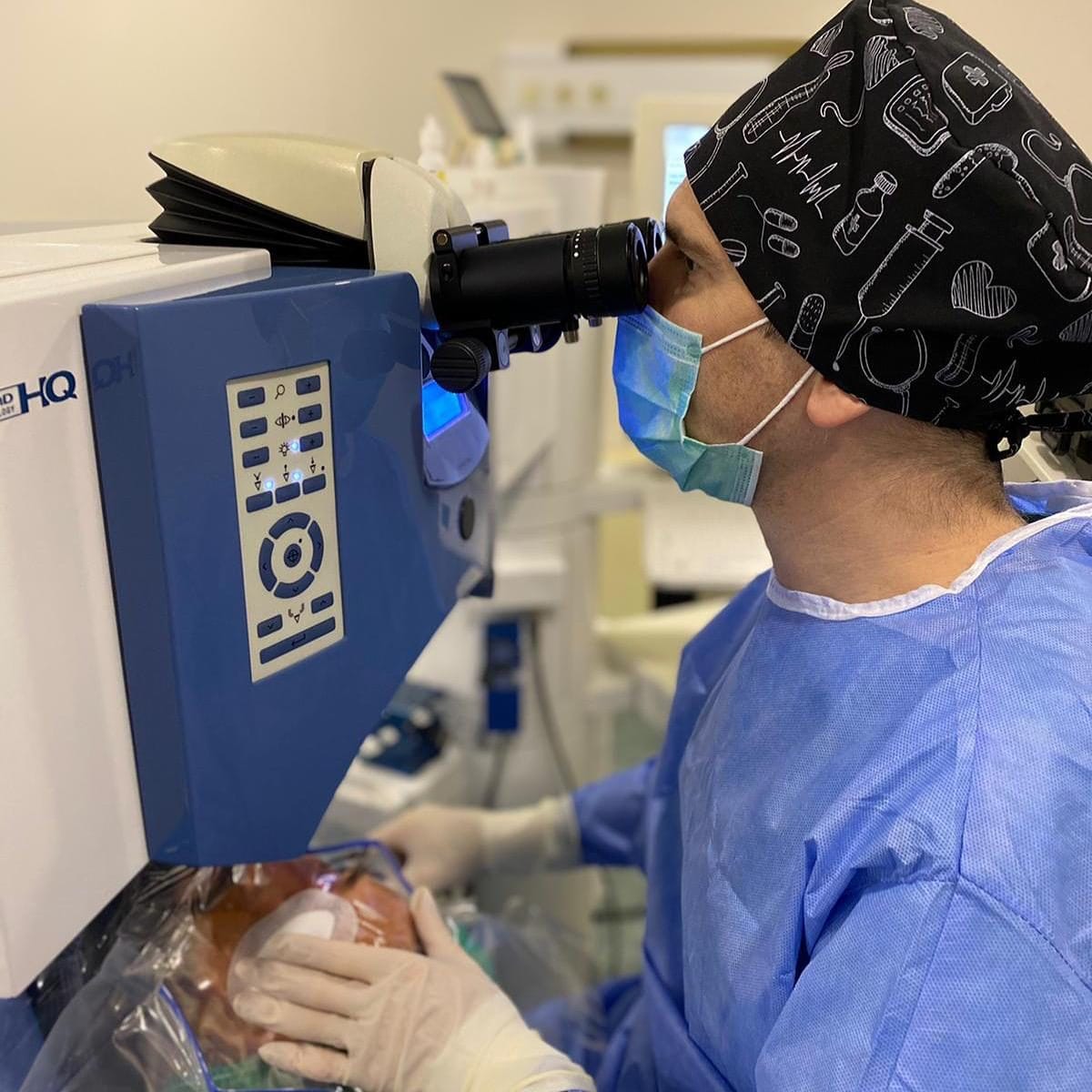
- No Touch laser: Drops numb the eye. Then the excimer laser reshapes the surface layer and the irregular corneal surface without any instrument touching the eye.
- Cross-linking: In the same session, we apply riboflavin and strengthen the cornea with UVA light.
- Protective lens: We place a bandage contact lens; the patient goes home the same day.
How we perform combined CXL + No Touch: Step-by-step illustration
No-touch surface laser and cross-linking in the same session.
- PlanningBased on corneal tomography, we prepare a personalised laser plan to reduce irregularity while removing as little tissue as possible.
- No Touch laserWithout any instrument touching the eye, the excimer laser partially corrects the surface layer and the irregular corneal surface.
- Cross-linkingIn the same session, we apply riboflavin and strengthen the cornea with UVA light.
- Protective lensWe place a bandage contact lens and the patient goes home the same day. The cornea becomes more regular and more resistant.
Outcomes of combined CXL + No Touch and scientific evidence
In a study comparing 325 eyes (Kanellopoulos, J Refract Surg 2009), same-day combined treatment gave better results in terms of vision, reduction in corneal steepness and haze. The comparison was with the method of performing CXL first and applying the laser 6 months later. In the 10-year results of the Athens protocol, the disease remained stable in 94.4% of eyes and corneal steepness decreased markedly. However, a hyperopic shift over time occurred in 3.5%. Patient selection and limiting the laser dose are therefore critical.
Prof. Dr. Fırat Helvacıoğlu’s work
Prof. Dr. Fırat Helvacıoğlu and his team presented the short-term, 2-year, 3-year and long-term results of this treatment, which combines corneal wavefront-guided surface normalisation with cross-linking stabilisation in keratoconus, at ESCRS (European Society of Cataract and Refractive Surgeons) congresses between 2016 and 2019. In a 36-year-old patient included in these presentations, two years after treatment uncorrected visual acuity improved from 0.05 to 0.7 and corrected acuity from 0.3 to 1.0 (decimal), with no corneal haze (this is the result of a single patient; outcomes vary from person to person). For planning principles and safety limits, see: Hybrid treatment for keratoconus.
Recovery
Recovery is similar to No Touch laser and CXL. Grittiness, watering and light sensitivity occur for the first 2–3 days; the surface layer usually closes in 3–5 days and then we remove the bandage lens. Vision clears over the following weeks and may take 3–6 months to stabilise fully. Sun protection and regular use of drops are important to reduce the risk of corneal haze. International patients should plan a stay of about one week in Istanbul.
Related pages: Cross-linking (CXL) · No Touch laser · Keratoconus treatment
Frequently asked questions
No. Applying laser alone to a keratoconic cornea can accelerate the disease. In keratoconus, we apply No Touch laser only in combination with cross-linking in the same session, and at a limited dose.
The aim is not to eliminate the prescription completely but to regularise the cornea. Vision improves markedly in many patients; however, a mild prescription may remain, and glasses or soft lenses can correct it.
We prefer combined treatment in mild to moderate cases with adequate corneal thickness. CAIRS and intracorneal ring segments (ICRS) come to the fore for steeper cones or thinner corneas. The choice is based on tomography measurements.
Yes. In Prof. Dr. Fırat Helvacıoğlu’s practice, the laser and cross-linking take place in the same session. Also, in suitable patients, he can treat both eyes on the same day. As both eyes will be gritty and blurred for the first few days, rest should be planned for this period.
References
- Kanellopoulos AJ. Ten-year outcomes of progressive keratoconus management with the Athens Protocol (topography-guided partial-refraction PRK combined with CXL). J Refract Surg. 2019;35(8):478–483. doi:10.3928/1081597X-20190627-01
- Kanellopoulos AJ. Comparison of sequential vs same-day simultaneous collagen cross-linking and topography-guided PRK for treatment of keratoconus. J Refract Surg. 2009;25(9):S812–S818. doi:10.3928/1081597X-20090813-10
- Krueger RR, Kanellopoulos AJ. Stability of simultaneous topography-guided photorefractive keratectomy and riboflavin/UVA cross-linking for progressive keratoconus. J Refract Surg. 2010;26(10):S827–S832. doi:10.3928/1081597X-20100921-11
- Larkin DFP et al. Effect of corneal cross-linking versus standard care on keratoconus progression in young patients: the KERALINK randomized controlled trial. Ophthalmology. 2021;128(11):1516–1526. doi:10.1016/j.ophtha.2021.04.019
- Gomes JA et al. Global consensus on keratoconus and ectatic diseases. Cornea. 2015;34(4):359–369. doi:10.1097/ICO.0000000000000408
This page provides patient information and does not replace an examination or medical assessment. In addition, we determine the treatment that is right for you after an eye examination and measurements.
Book a combined treatment suitability assessment
Prof. Dr. Fırat Helvacıoğlu · Veni Vidi Eye Clinic, Bağdat Caddesi No: 257, Caddebostan – Kadıköy, Istanbul, Türkiye