
Topography- and Wavefront-Guided Laser
Personalised laser treatment planning · Prof. Dr. Fırat Helvacıoğlu, FEBOS-CR · Veni Vidi Eye Clinic, Caddebostan – Kadıköy, Istanbul
Topography- and wavefront-guided laser treatments are excimer laser treatments that we plan individually. We base each plan on the corneal map or on the optical aberrations of the eye. In addition to the spectacle prescription, these treatments target corneal irregularities and higher-order aberrations. At international congresses, Prof. Dr. Fırat Helvacıoğlu has presented the long-term results of a hybrid treatment for keratoconus. This treatment combines corneal wavefront-guided TransPRK with cross-linking in the same session.
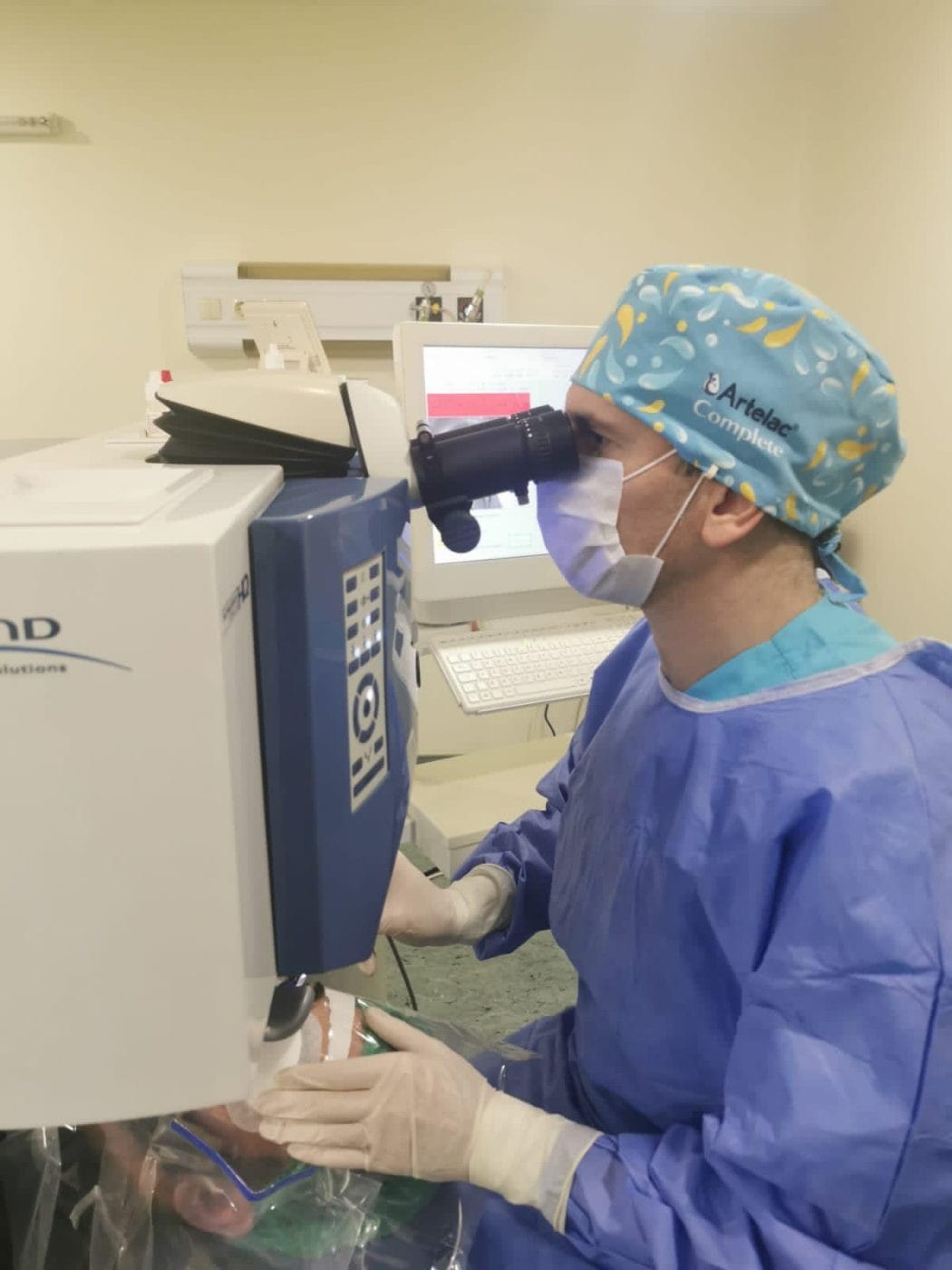
What is topography- and wavefront-guided laser?
In topography- and wavefront-guided laser treatments, we plan the excimer ablation individually. We base it on the eye’s own measurements rather than on the same profile for everyone. Standard treatment corrects only the spectacle prescription (myopia, hyperopia, astigmatism). Personalised treatment also considers the corneal surface map or small imperfections throughout the eye’s optical system (higher-order aberrations).
- Topography-guided laser: We map the front surface of the cornea from thousands of points. Then we plan the laser to correct corneal irregularities together with the prescription.
- Wavefront-guided laser: We can measure optical aberrations for the cornea alone (corneal wavefront, CW). Alternatively, an aberrometer measures them for the whole eye, including the cornea and crystalline lens (ocular wavefront, OW). In irregular corneas, where the cornea is the source of the aberration, we generally prefer corneal wavefront-guided treatment.
- Wavefront-optimised treatment: This does not use individual measurements. Instead, it is an advanced standard profile. This profile better preserves the natural shape of the cornea and protects night-time visual quality.
Personalised treatment is not a separate operation but a planning method. We deliver it with surface treatment (PRK, No Touch) or LASIK.
Corneal wavefront-guided hybrid treatment for keratoconus
Prof. Dr. Fırat Helvacıoğlu’s main area of work in personalised laser treatment is the “hybrid treatment” for keratoconus. It combines corneal wavefront (CW)-guided No Touch (TransPRK) surface treatment with corneal cross-linking (CXL) in the same session. This approach, a modified Athens protocol, has two combined goals:
- Normalisation: To bring the asymmetric steep areas closer to physiological values as far as the cornea allows. This also means smoothing the surface and improving visual quality by reducing higher-order aberrations.
- Stabilisation: To reduce the risk of disease progression with CXL performed in the same session.
How do we plan the treatment?
- Adjusted manifest refraction: In keratoconic eyes, subjective refraction has limited reliability. We calculate an “adjusted” treatment refraction by evaluating the spectacle prescription, corneal topography and corneal wavefront measurements together. Without this step, the treatment would correct higher-order aberrations twice.
- Measurements: We map the corneal wavefront with a Scheimpflug camera and Placido rings, and the ocular wavefront with aberrometry. Before treatment, the measurements must be consistent with each other.
- Safety limits: We keep the total ablation depth, including the epithelium, below about 110 microns. The aim is that the residual corneal thickness after treatment does not fall below 400 microns. We adjust the treatment profile to these limits.
- Cross-linking (CXL): After the laser, we apply riboflavin drops, followed by ultraviolet-A light (total energy 5.4 J/cm²). Keeping the corneal surface moist and cool during treatment is important to prevent haze.
We generally consider the hybrid treatment for patients with stage 1–3 keratoconus. However, it is not suitable if the cornea is very thin or the K value is very high. The same applies if we cannot obtain a spectacle refraction or if there is a deep corneal scar. In these patients, the options are corneal ring segments, CXL alone or keratoconus contact lenses.
More information: Combined CXL + No Touch · Cross-linking (CXL)
Prof. Dr. Fırat Helvacıoğlu’s scientific presentations in this field
Prof. Dr. Fırat Helvacıoğlu and his team followed the outcomes of corneal wavefront-guided surface treatment in keratoconus over several years. They presented the results at international congresses:
- Outcomes of corneal wavefront-guided surface ablation in the treatment of keratoconus — Sunay E, Helvacıoğlu F. SCHWIND User Meeting, Istanbul, 2016.
- Corneal wavefront-guided normalisation and CXL stabilisation in keratoconus: short-term results — Sunay E, Helvacıoğlu F et al. 34th ESCRS Congress, Copenhagen, 2016.
- … 2-year results — 35th ESCRS Congress, Lisbon, 2017.
- … 3-year results — 36th ESCRS Congress, Vienna, 2018.
- … long-term results — 37th ESCRS Congress, Paris, 2019; 53rd National Congress of the Turkish Ophthalmological Association, Antalya, 2019.
- Visual, refractive, topographic and wavefront outcomes of TransPRK in virgin eyes — Kaya Ünsal S, Helvacıoğlu F, Sunay E. 37th ESCRS Congress, Paris, 2019.
- Fine-tuning with PRK after multifocal intraocular lens implantation — Helvacıoğlu F et al. 36th ESCRS Congress, Vienna, 2018.
Topography-guided laser: treating the source of astigmatism
The astigmatism measured in a spectacle examination does not come from a single source. Part of it arises from the cornea and part from the crystalline lens inside the eye. We call the difference between these two components ocular residual astigmatism (ORA). The corneal and refractive astigmatism may differ significantly. In that case, applying the entire spectacle astigmatism to the cornea may leave permanent astigmatism after surgery. The problem may also grow later in life as the lens changes.
Alpins vector analysis separates the components of astigmatism. Published data show that the efficacy of laser treatment decreases as ORA increases. For example, one study examined 267 myopic eyes with zero refractive cylinder (Frings et al., PLoS One 2015). In this study, each 1-dioptre increase in pre-operative ORA reduced the efficacy index by 0.07. In topography-guided laser treatments, planning can take the measured corneal astigmatism into account. Studies have shown that this gives better results than planning based on spectacle astigmatism alone.
Prof. Dr. Fırat Helvacıoğlu’s contribution
RLES AI is a clinical decision support platform for refractive surgery. Prof. Dr. Fırat Helvacıoğlu is a member of its Medical Advisory Board. Together with other clinicians, he also performed the clinical validation of its wavefront- and topography-guided ablation planning module. The module separates astigmatism into Alpins vectors to calculate ORA. With graded thresholds, it flags which eyes are suitable for standard planning. It also flags which eyes require planning according to the source of astigmatism. Finally, it checks the values to enter on the laser planning screen. The surgical decision always rests with the surgeon; the decision support system assists the surgeon’s assessment.
Who is topography- and wavefront-guided laser suitable for?
- People with irregular corneas: Decentred or small optical zones from previous laser treatment, radial keratotomy (RK), irregular astigmatism after corneal transplantation, corneal scars.
- People with night vision complaints: Symptoms related to higher-order aberrations, such as halos, glare and ghosting.
- Mismatch between refractive and corneal astigmatism: Eyes with high ORA, where the astigmatism axis differs between the spectacle prescription and the corneal map.
- Selected cases of keratoconus: The hybrid treatment combining corneal wavefront-guided TransPRK with cross-linking in the same session in stage 1–3 keratoconus.
- Standard myopia and astigmatism: Comparative studies have shown that topography-guided treatment may offer advantages in terms of visual quality.
- Age: At least 18; the most suitable period is usually between 18 and 40.
- Stable prescription: Your prescription should not have changed significantly (by more than 0.5 dioptres) in the past year.
- Healthy cornea: Corneal mapping (topography/tomography) and thickness measurements must be normal, and these tests must rule out keratoconus.
- General health: We do not perform surgery during pregnancy or breastfeeding. We also assess uncontrolled diabetes and certain rheumatic and immune disorders carefully.
- Eye health: We first treat significant dry eye, blepharitis or intraocular disease.
How do we plan personalised treatment?
- Preparing the ocular surface: Dry eye and contact lens–induced corneal changes distort the map. If necessary, we treat these first, and you stop wearing your lenses for a sufficient period.
- Repeated measurements: We take corneal topography and tomography several times and select consistent measurements. For wavefront treatment, we also perform aberrometry and pupil measurements.
- Analysis of astigmatism: We compare refractive and corneal astigmatism vectorially. Then we calculate ORA and determine the treatment values.
- Safety calculations: We check corneal thickness, residual tissue and percent tissue altered (PTA). In personalised treatment, the amount of tissue removed may differ from standard treatment.
- Treatment: We transfer the plan to the laser and deliver it with the chosen method (surface treatment or LASIK).
Scientific evidence on topography- and wavefront-guided laser
A meta-analysis of 7 randomised trials (1,168 eyes; Cheng et al., J Refract Surg 2021) found similar rates of uncorrected 20/20 vision with topography-guided and wavefront-optimised LASIK. However, topography-guided treatment achieved a higher rate of reaching the target refraction and induced fewer higher-order aberrations. Another meta-analysis of 11 studies (1,425 eyes; Hu et al., Int J Ophthalmol 2021) reported similar results.
Researchers conducted a multicentre topography-guided LASIK study for FDA approval in the United States. In this study, post-operative uncorrected vision was as good as or better than pre-operative corrected vision in 90% of eyes. Most patients’ night vision complaints also decreased.
A Cochrane review compared wavefront-guided with standard treatments. It showed no clear difference in uncorrected vision and noted that the level of evidence was low. Personalised treatment is therefore not a routine option for every eye. Instead, it is a planning method that provides meaningful benefit in the right patient.
Cost and information for international patients
We determine the cost after the examination. It depends on the need for personalised planning, the method used and whether we treat one or both eyes. Laser vision correction is an elective procedure, and health insurance generally does not cover it. International patients can send their topography and previous reports via WhatsApp for a preliminary assessment.
Related pages: Laser eye surgery · No Touch · PRK · Q-LASIK · Femto-LASIK
Frequently asked questions
In stage 1–3 keratoconus, we can combine corneal wavefront-guided TransPRK and cross-linking in the same session. The aim is both to regularise the cornea and to halt disease progression. Corneal thickness and stage must be suitable.
Topography-guided laser is a personalised laser treatment. We plan it according to a surface map of the cornea derived from thousands of points. It aims to correct corneal irregularities together with the spectacle prescription.
Topography-guided treatment is based solely on the surface map of the cornea. Wavefront-guided treatment, however, is based on the aberrations of the eye’s entire optical system, including the cornea and crystalline lens.
No. In many patients with a regular cornea, standard or wavefront-optimised treatment gives excellent results. Personalised treatment is particularly beneficial for irregular corneas and for enhancements after previous surgery. The same is true for eyes in which refractive and corneal astigmatism do not match.
If the cornea is thick enough, topography-guided laser can often reduce irregularities caused by decentred or small-zone treatments. We make the decision after detailed measurements.
We can deliver personalised planning with surface treatments such as PRK and No Touch, or with LASIK. Corneal thickness and the type of irregularity determine the appropriate one.
References
- Sunay E, Helvacıoğlu F, Kavalcıoğlu Ö, Akyurt A, Kaya Ünsal S, Akın T. Two year outcomes of keratoconus management with corneal wavefront-guided normalization combined with corneal cross-linking stabilization. 35th ESCRS Congress, Lisbon, 2017 (presentation).
- Sunay E, Helvacıoğlu F, Kaya Ünsal S, Kavalcıoğlu Ö, Bulut E. Long-term outcomes of keratoconus management with corneal wavefront-guided normalisation combined with corneal cross-linking stabilisation. 37th ESCRS Congress, Paris, 2019 (presentation).
- Kaya Ünsal S, Helvacıoğlu F, Sunay E. Visual, refractive, topographic and wavefront outcomes of trans photorefractive keratectomy in virgin eyes. 37th ESCRS Congress, Paris, 2019 (presentation).
- Cheng SM et al. Topography-guided versus wavefront-optimized LASIK for myopia with and without astigmatism: a meta-analysis. J Refract Surg. 2021;37(10):707–714. doi:10.3928/1081597X-20210709-01
- Hu PC et al. Visual differences in topography-guided versus wavefront-optimized LASIK in the treatment of myopia: a meta-analysis. Int J Ophthalmol. 2021;14(10):1602–1609. doi:10.18240/ijo.2021.10.19
- Stulting RD et al. Results of topography-guided laser in situ keratomileusis custom ablation treatment with a refractive excimer laser. J Cataract Refract Surg. 2016;42(1):11–18. doi:10.1016/j.jcrs.2015.08.016
- Stulting RD et al. Topography-guided refractive astigmatism outcomes: predictions comparing three different programming methods. Clin Ophthalmol. 2020;14:1091–1100. doi:10.2147/OPTH.S244079
- Alpins N. Astigmatism analysis by the Alpins method. J Cataract Refract Surg. 2001;27(1):31–49. doi:10.1016/s0886-3350(00)00798-7
- Frings A et al. LASIK for spherical refractive myopia: effect of topographic astigmatism (ocular residual astigmatism, ORA) on refractive outcome. PLoS One. 2015;10(4):e0124313. doi:10.1371/journal.pone.0124313
- Li SM et al. Wavefront excimer laser refractive surgery for adults with refractive errors. Cochrane Database Syst Rev. 2020. doi:10.1002/14651858.CD012687.pub2
This page is for patient information and does not replace an examination or medical assessment. We determine the treatment that is right for you after an eye examination and measurements.
Book a personalised laser suitability assessment
Prof. Dr. Fırat Helvacıoğlu · Veni Vidi Eye Clinic, Bağdat Caddesi No: 257, Caddebostan – Kadıköy, Istanbul, Türkiye