
Femto-LASIK (iLASIK)
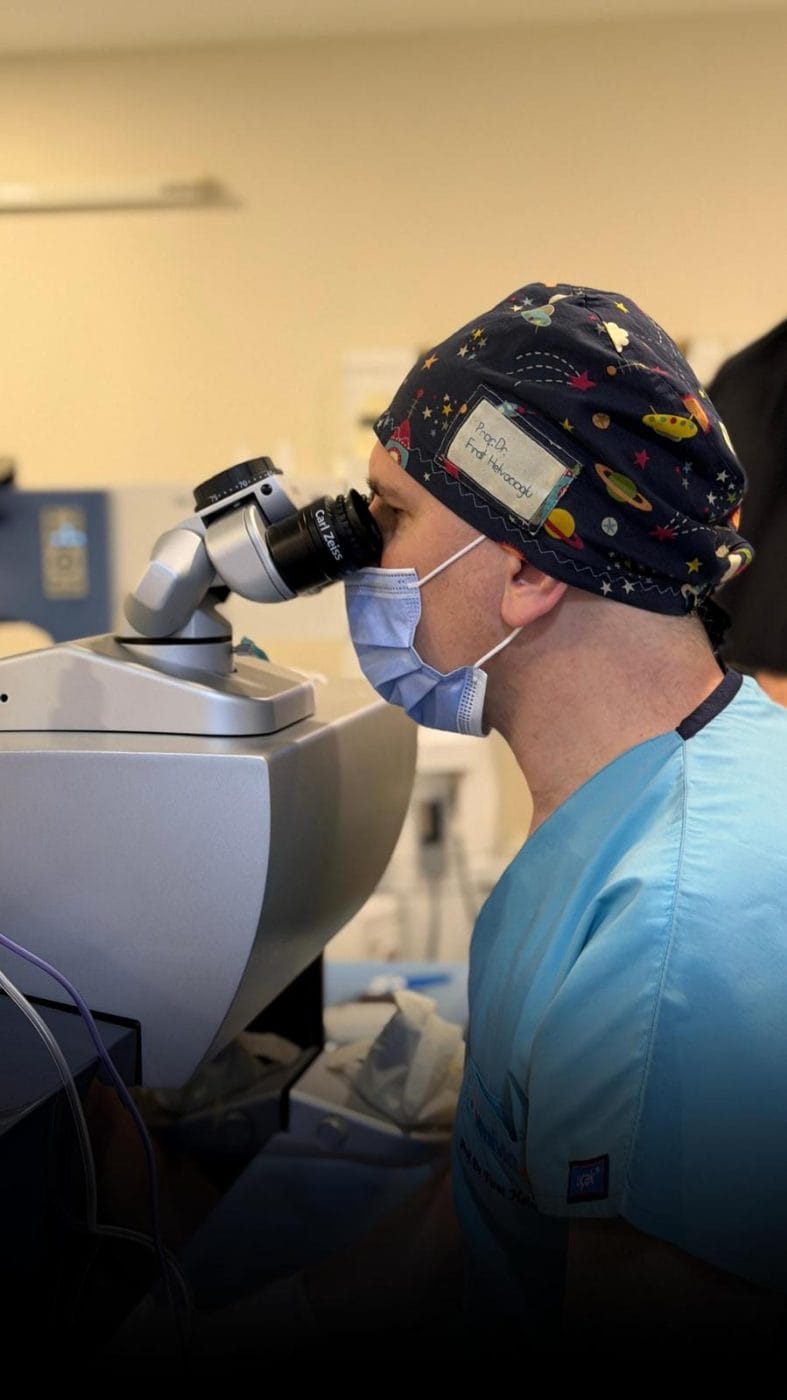
LASIK with a femtosecond laser–created flap · Prof. Dr. Fırat Helvacıoğlu, FEBOS-CR · Veni Vidi Eye Clinic, Caddebostan – Kadıköy, Istanbul
Femto-LASIK is a LASIK procedure in which a femtosecond laser creates the thin corneal flap instead of a microkeratome. The excimer laser then corrects the prescription. It corrects myopia, hyperopia and astigmatism; the procedure takes 15–20 minutes for both eyes, and vision usually clears by the next day.
What is Femto-LASIK (iLASIK)?
Femto-LASIK is an all-laser LASIK procedure in which a femtosecond laser creates the thin corneal flap instead of a microkeratome. The excimer laser then reshapes the underlying tissue. We use Femto-LASIK to correct myopia, hyperopia and astigmatism.
iLASIK refers to the combination of a femtosecond laser–created flap with an excimer laser treatment personalised according to a wavefront map, which measures the optical aberrations of the eye. The aim of both procedures is to eliminate or minimise the need for glasses and contact lenses.
How does Femto-LASIK work?
- Anaesthesia: We numb the eye with anaesthetic drops, so you feel no pain during surgery.
- Flap: The femtosecond laser creates a thin corneal flap of the planned thickness.
- Excimer laser: The surgeon lifts the flap, and then the excimer laser corrects the prescription according to the personalised plan.
- Repositioning the flap: The surgeon lays the flap back in place; it needs no stitches because it adheres on its own.
The total procedure time for both eyes is usually 15–20 minutes; the patient goes home the same day.
Step-by-step illustration of the treatment
All-laser LASIK with a femtosecond laser–created flap.
- Creating the flap with a laserThe femtosecond laser creates a thin flap of the planned thickness without using a microkeratome.
- Lifting the flapThe surgeon gently lifts the flap on its hinge, exposing the underlying corneal tissue.
- Excimer laserThe excimer laser reshapes the exposed tissue according to the personalised plan, correcting the prescription.
- Repositioning the flapThe surgeon lays the flap back in place, and it adheres without stitches; vision usually clears markedly by the next day.
Who is Femto-LASIK suitable for?
We can perform Femto-LASIK in patients with myopia, hyperopia and astigmatism who have adequate and regular corneal structure. For thin or irregular corneas, No Touch may be more suitable, and for high prescriptions an implantable lens (ICL); we do not perform laser surgery in eyes with suspected keratoconus.
- Age: At least 18; the most suitable period is usually between 18 and 40.
- Stable prescription: Your prescription should not have changed significantly (by more than 0.5 dioptres) in the past year.
- Healthy cornea: Corneal mapping (topography/tomography) and thickness measurements must be normal, and we must rule out keratoconus.
- General health: We do not perform surgery during pregnancy or breastfeeding. We also assess uncontrolled diabetes and certain rheumatic and immune disorders carefully.
- Eye health: We first treat significant dry eye, blepharitis or intraocular disease.
Femto-LASIK, Q-LASIK and SMILE Pro compared
| Feature | Femto-LASIK | Q-LASIK | SMILE Pro |
|---|---|---|---|
| Flap | Created with a femtosecond laser | Created in ~7 seconds with low suction using the ML7 LASIK system | No flap; 2–4 mm incision |
| Correction of the prescription | Excimer laser | Excimer laser | Removal of a tissue layer created with the femtosecond laser |
| Visual recovery | Usually the next day | 5–6 hours in most patients | Within a few days |
| Correctable errors | Myopia, hyperopia, astigmatism | Myopia, hyperopia, astigmatism | Myopia and astigmatism |
Comparative meta-analyses have found similar visual outcomes with SMILE and Femto-LASIK. Your corneal measurements and lifestyle determine which method is right for you.
Is Femto-LASIK safe? Outcomes and evidence
The femtosecond laser allows us to plan the thickness and shape of the flap precisely. In a systematic review of 27 studies including a total of 28,531 eyes, the rate of incomplete flaps was 0.17%; inflammation under the flap (diffuse lamellar keratitis, DLK) occurred in 6.3% of patients and usually resolved without lasting effects on vision. Serious flap complications occur in less than 1%. According to a Cochrane review, visual outcomes are similar to LASIK with a mechanically created flap.
The most important safety consideration in laser treatment is the risk of ectasia — weakening and forward bulging of the cornea. The strongest risk indicators for ectasia include the percent tissue altered (PTA), which reflects how much of the cornea the treatment changes. Studies have shown that 97% of eyes with normal topography that developed ectasia had a PTA of 40% or more. For this reason, we calculate corneal thickness, topography and PTA together for every plan, and we choose a safer method instead of a risky plan.
Safe planning
Prof. Dr. Fırat Helvacıoğlu is a member of the Medical Advisory Board of RLES AI, a clinical decision support platform to whose laser planning, keratoconus screening and dry eye analysis modules he has contributed. The surgical decision always rests with the surgeon.
Recovery after Femto-LASIK
- First hours: Mild burning, watering and light sensitivity; we recommend rest.
- Day 1: Vision clears markedly in most patients; the first check-up takes place.
- Week 1: Do not rub the eye; use your drops regularly. Most patients return to desk work within 1–2 days.
- Months 1–3: Vision and the ocular surface stabilise; halos around headlights at night and dry eye are mostly temporary.
Femto-LASIK cost and information for international patients
We determine the cost after the examination. Laser vision correction is an elective procedure, and health insurance generally does not cover it. For international patients: you can complete the assessment, surgery and day-1 check within about 3–4 days in Istanbul. Consultations are available in English.
Other methods: Q-LASIK · SMILE Pro · No Touch · All laser methods
Frequently asked questions
Both procedures create a thin flap in the cornea, and then the excimer laser corrects the prescription. In Femto-LASIK, a femtosecond laser creates the flap instead of a microkeratome, which is why people also call it all-laser LASIK.
iLASIK refers to the Femto-LASIK procedure that combines a femtosecond laser–created flap with an excimer laser treatment personalised according to a wavefront measurement of the eye.
We perform the operation under topical anaesthesia, so you feel no pain. However, mild burning and watering may occur for a few hours after surgery.
Vision usually clears markedly by the next day; most patients return to daily life and desk work within 1–2 days.
Visual outcomes are similar. Femto-LASIK can treat a wider range of prescriptions, including hyperopia; however, because SMILE Pro has no flap, it may have advantages for people prone to dry eye and for contact sports.
In correctly selected patients with a stable prescription, the result is permanent. However, difficulty with near vision that appears in the 40s (presbyopia) is a separate, age-related condition.
References
- Butt AB et al. Incidence of femtosecond laser-assisted LASIK flap complications: a systematic review (28,531 eyes). J Cataract Refract Surg. 2026. doi:10.1097/j.jcrs.0000000000002031
- Kahuam-López N et al. LASIK with a mechanical microkeratome compared to LASIK with a femtosecond laser for LASIK in adults with myopia or myopic astigmatism. Cochrane Database Syst Rev. 2020;4(4):CD012946. doi:10.1002/14651858.CD012946.pub2
- Shen Z et al. Small incision lenticule extraction (SMILE) versus femtosecond laser-assisted in situ keratomileusis (FS-LASIK) for myopia: a systematic review and meta-analysis. PLoS One. 2016;11(7):e0158176. doi:10.1371/journal.pone.0158176
- Li SM et al. Wavefront excimer laser refractive surgery for adults with refractive errors. Cochrane Database Syst Rev. 2020. doi:10.1002/14651858.CD012687.pub2
- Santhiago MR et al. Association between the percent tissue altered and post-laser in situ keratomileusis ectasia in eyes with normal preoperative topography. Am J Ophthalmol. 2014;158(1):87–95. doi:10.1016/j.ajo.2014.04.002
- Eydelman M et al. Symptoms and satisfaction of patients in the Patient-Reported Outcomes With Laser In Situ Keratomileusis (PROWL) studies. JAMA Ophthalmol. 2017;135(1):13–22. doi:10.1001/jamaophthalmol.2016.4587
This page provides patient information and does not replace an examination or medical assessment. We determine the treatment that is right for you after an eye examination and measurements.
Book a Femto-LASIK suitability assessment
Prof. Dr. Fırat Helvacıoğlu · Veni Vidi Eye Clinic, Bağdat Caddesi No: 257, Caddebostan – Kadıköy, Istanbul, Türkiye