
SMILE Pro Laser
Flapless, small-incision laser · ZEISS VISUMAX 800 · Prof. Dr. Fırat Helvacıoğlu, FEBOS-CR · Veni Vidi Eye Clinic, Caddebostan – Kadıköy, Istanbul
SMILE Pro is a laser procedure that corrects myopia and astigmatism by removing a thin disc of tissue, created with a laser inside the cornea, through a small 2–4 mm incision — without cutting a corneal flap. The laser time is under 10 seconds per eye, and most patients return to daily life the next day.
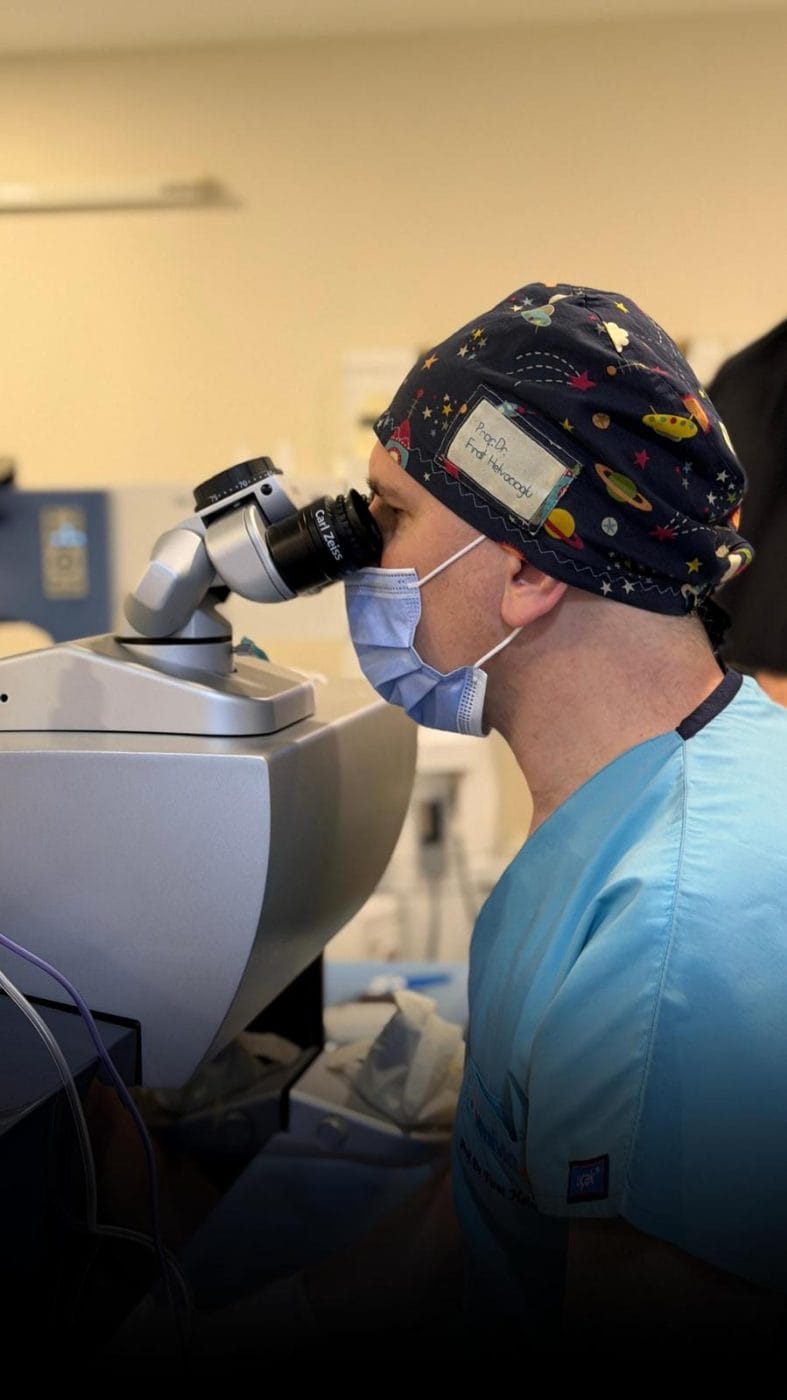
What is SMILE Pro?
SMILE Pro is a laser procedure that corrects myopia and astigmatism by removing a thin disc of tissue (lenticule), created inside the cornea, through a small incision — without cutting a flap on the corneal surface. “SMILE” stands for Small Incision Lenticule Extraction. In SMILE Pro, the surgeon performs this procedure with the new-generation ZEISS VISUMAX 800 femtosecond laser.
The new-generation laser creates the lenticule in under 10 seconds, compared to about 28 seconds on the previous-generation device. A shorter laser time shortens the period during which the patient must keep a steady gaze.
How does SMILE Pro work?
- Anaesthesia: First, drops numb the eye; the patient is awake and feels no pain.
- Creating the lenticule: The femtosecond laser then creates a thin layer of tissue (lenticule) inside the cornea, matching the correction needed.
- Small incision: At the same time, the laser creates a small 2–4 mm access incision at the edge of the cornea.
- Removing the lenticule: Finally, the surgeon removes the lenticule through this small incision, and the cornea takes on its new shape. There is no flap to lift and no need for stitches.
Step-by-step illustration of the procedure
Laser treatment through a small incision, without cutting a corneal flap.
- Creating the lenticuleThe femtosecond laser creates a thin layer of tissue (lenticule) within the cornea, matching the correction needed, together with a small 2–4 mm incision.
- Separating the lenticuleThe lenticule is gently separated from the surrounding corneal tissue. No flap is created on the corneal surface.
- Removal through a small incisionThe lenticule is removed through the small 2–4 mm incision.
- New corneal shapeWith the tissue removed, the cornea flattens and the prescription is corrected; the small incision heals without stitches.
What are the advantages of SMILE Pro?
- No flap: Instead of the roughly 20 mm flap edge in LASIK, the surgeon makes only a 2–4 mm incision; flap-related complications do not occur.
- Less dry eye: Because the nerves in the corneal surface are less affected, meta-analyses have shown milder dry eye signs in the first months compared with Femto-LASIK.
- Active lifestyles: Since there is no flap, there is no risk of flap displacement after trauma.
- Similar visual outcomes: Comparative meta-analyses have also reported similar visual acuity and predictability with SMILE and Femto-LASIK.
Who is SMILE Pro suitable for?
We use SMILE Pro mainly for myopia and myopic astigmatism. The manufacturer states a treatment range of up to −10 dioptres of myopia and up to 5 dioptres of astigmatism. Although European approval also covers the treatment of hyperopia, clinical data in this area are still limited. Corneal thickness and topography measurements determine final suitability.
- Age: At least 18; the most suitable period is usually between 18 and 40.
- Stable prescription: Your prescription should not have changed significantly (by more than 0.5 dioptres) in the past year.
- Healthy cornea: Corneal mapping (topography/tomography) and thickness measurements must be normal, and the tests must rule out keratoconus.
- General health: We do not perform surgery during pregnancy or breastfeeding, and we carefully assess uncontrolled diabetes and certain rheumatic and immune disorders.
- Eye health: We treat significant dry eye, blepharitis or intraocular disease first.
Recovery after SMILE Pro
| Time | What to expect |
|---|---|
| First hours | Mild burning, watering and blurring; we recommend rest |
| Day 1 | First check-up; most patients return to daily life |
| Week 1 | Vision gradually sharpens; with SMILE, full visual clarity may take a few days longer than with LASIK |
| Months 1–3 | Vision stabilises; we manage dry eye, if present, with drops |
Do not rub the eye or let water and soap get into it during the first week. You should generally avoid swimming pools and the sea for 2 weeks.
Does SMILE Pro have risks?
In a SMILE Pro series of 916 eyes, surgeons completed 99.45% of procedures without complications. Beyond month 3, the series recorded dry eye in 1.65% and halo/glare complaints in 0.88%. Ectasia (weakening of the cornea) is a rare but serious risk with all laser methods. Therefore, we assess the corneal structure in detail at the consultation.
The most important safety consideration in laser treatment is the risk of ectasia — weakening and forward bulging of the cornea. The percent tissue altered (PTA) reflects how much of the cornea the treatment changes, and it is one of the strongest risk indicators for ectasia. In one case-control study, researchers examined 30 eyes that developed ectasia after LASIK despite normal topography. In 97% of these eyes, the PTA was 40% or more (Santhiago et al., Am J Ophthalmol 2014). For this reason, we calculate corneal thickness, topography and PTA together for every plan, and we choose a safer method instead of a risky plan.
SMILE Pro, No Touch or Femto-LASIK?
| Feature | SMILE Pro | No Touch | Femto-LASIK |
|---|---|---|---|
| Flap | No | No | Yes |
| Incision | 2–4 mm | None (surface treatment) | ~20 mm flap edge |
| Pain / discomfort | Mild | Noticeable for the first 2–3 days | Mild |
| Visual recovery | A few days | 3–7 days | Fastest (day 1) |
| Hyperopia | Limited data | Suitable | Suitable |
Other methods: No Touch laser · Q-LASIK · Femto-LASIK
SMILE Pro cost and information for international patients
We determine the cost of SMILE Pro after the examination, depending on whether we treat one or both eyes. Laser vision correction is an elective procedure, and health insurance generally does not cover it. For international patients: we can complete the assessment and treatment within a few days. We recommend staying in Istanbul for about 3–4 days in total so that we can perform the day-1 check. Consultations are also available in English.
Frequently asked questions
The laser runs for less than 10 seconds per eye. Together with preparation, the procedure for both eyes usually takes 15–20 minutes.
You feel no pain during surgery; only a brief sensation of pressure may occur. However, mild burning and watering for a few hours after surgery are normal.
Most patients can return to daily life and desk work the next day. For strenuous and contact sports, however, wait for the period recommended by your surgeon.
SMILE Pro has European approval for hyperopia, but clinical data are still limited. Surgeons generally prefer Femto-LASIK or No Touch for hyperopia.
In patients with a stable prescription, the result is largely permanent. However, a very small number of patients may need an enhancement; in that case, an examination determines the appropriate method.
Visual outcomes are similar. The advantages of SMILE Pro are the absence of a flap and less dry eye in the first months; with LASIK, on the other hand, vision clears more quickly and there is more experience in hyperopia.
References
- Kim JS, Chung SH. Comparison of lenticule creation time and clinical outcomes between VisuMax 800 and VisuMax 500. Sci Rep. 2025. doi:10.1038/s41598-025-98041-9
- Shen Z et al. Small incision lenticule extraction (SMILE) versus femtosecond laser-assisted in situ keratomileusis (FS-LASIK) for myopia: a systematic review and meta-analysis. PLoS One. 2016;11(7):e0158176. doi:10.1371/journal.pone.0158176
- Kobashi H et al. Dry eye after small incision lenticule extraction and femtosecond laser-assisted LASIK: meta-analysis. Cornea. 2017;36(1):85–91. doi:10.1097/ICO.0000000000000999
- Beckers et al. SMILE Pro: safety and outcomes (916 eyes). J Clin Med. 2026. doi:10.3390/jcm15124585
- Moshirfar M et al. Ectasia following small-incision lenticule extraction (SMILE): a review of the literature. Ophthalmol Ther. 2021;10:253–264. doi:10.1007/s40123-021-00383-w
- Santhiago MR et al. Association between the percent tissue altered and post-laser in situ keratomileusis ectasia in eyes with normal preoperative topography. Am J Ophthalmol. 2014;158(1):87–95. doi:10.1016/j.ajo.2014.04.002
This page is intended for patient information and does not replace an examination or medical assessment. The treatment that is right for you is determined after an eye examination and measurements.
Book a SMILE Pro suitability assessment
Prof. Dr. Fırat Helvacıoğlu · Veni Vidi Eye Clinic, Bağdat Caddesi No: 257, Caddebostan – Kadıköy, Istanbul, Türkiye