
Blepharoplasty – Eyelid Surgery
Upper and lower eyelid surgery · Dermatochalasis · Prof. Dr. Fırat Helvacıoğlu, FEBOS-CR · Veni Vidi Eye Clinic, Caddebostan – Kadıköy, Istanbul
Blepharoplasty is an operation that removes excess drooping skin and fat from the eyelids. It improves both appearance and the field of vision. Surgeons usually perform upper eyelid surgery under local anaesthesia in about an hour. The incision lies in the natural eyelid crease, which conceals it, and most patients return to social life within 7–10 days.
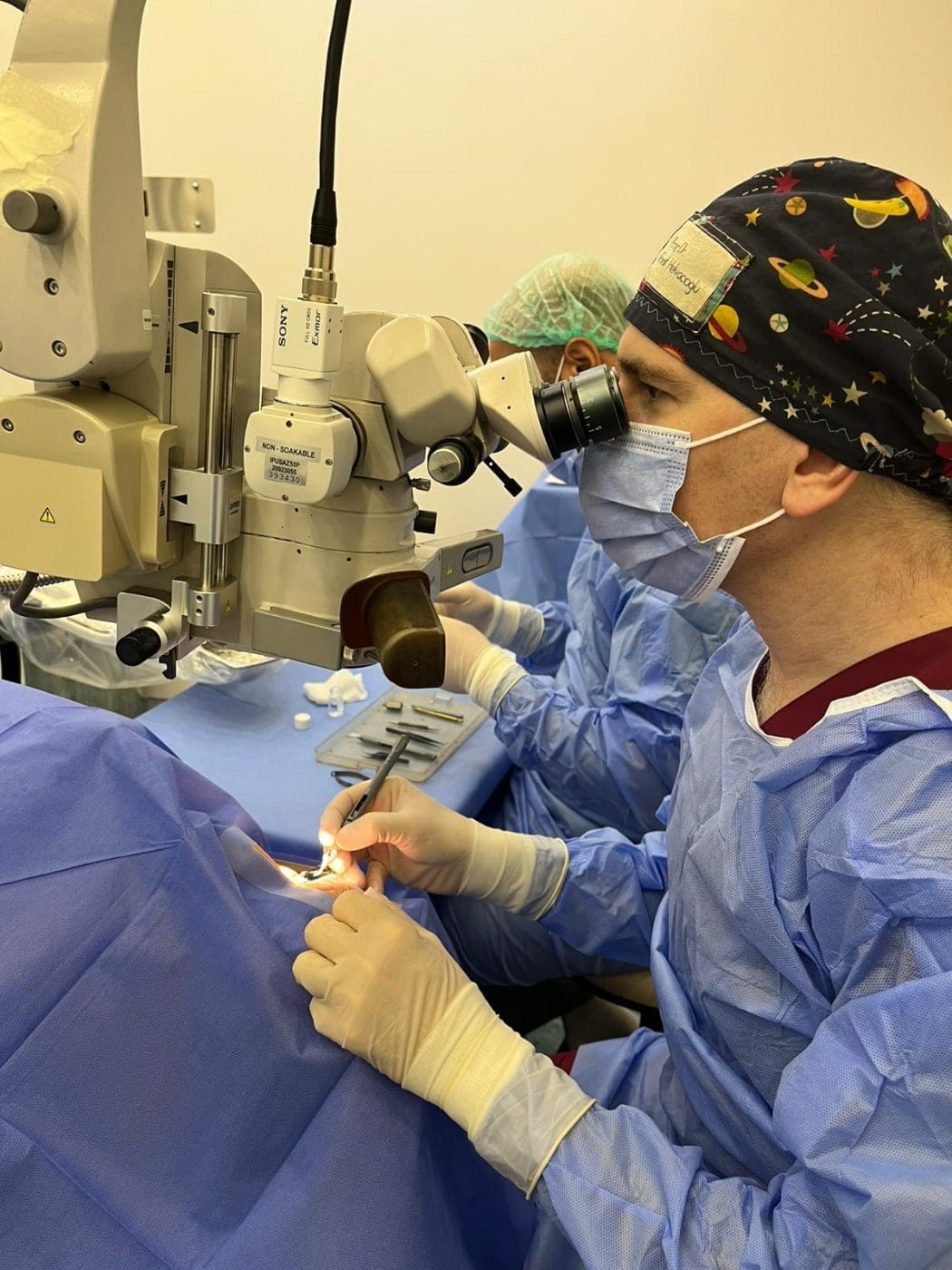
Blepharoplasty in brief
- Upper eyelid surgery usually takes about 45–60 minutes under local anaesthesia.
- The incision lies in the natural crease of the eyelid.
- The surgeon removes the stitches after about one week.
- Most patients return to social life within 7–10 days.
What is blepharoplasty?
Blepharoplasty is an operation that removes excess drooping skin and, when necessary, herniated fat from the eyelids. It improves both their function and appearance. In the upper eyelid, skin that loosens with age can hang over the eyelashes (dermatochalasis). This causes a tired appearance, a feeling of heaviness and narrowing of the upper visual field. In the lower eyelid, however, bags are the main concern.
How does the surgeon perform upper eyelid blepharoplasty?
Shows the correction of drooping upper eyelid skin, step by step.
- Drooping eyelid skinUpper eyelid skin that loosens with age hangs over the eyelashes (dermatochalasis). It can cause a feeling of heaviness and narrowing of the upper visual field.
- Planning and markingWith the patient sitting upright, the surgeon measures and marks the eyelid crease and the amount of excess skin to remove. The operation takes place under local anaesthesia.
- Removal of excess skin and fatThe surgeon removes the marked excess skin and, if necessary, also rebalances herniated fat in the eyelid.
- Closure in the natural creaseThe surgeon closes the incision with fine sutures in the natural eyelid crease, so the scar stays hidden there and fades over time.
Who is blepharoplasty suitable for?
- People whose upper eyelid skin hangs over the eyelashes and whose upper visual field has narrowed
- People with a feeling of heaviness in the eyelids, or fatigue and headaches from constantly raising the eyebrows
- People bothered by eyelid bags and a tired appearance
- People in good general health for surgery with realistic expectations
Sometimes the drooping comes not from the skin but from weakness of the muscle that lifts the eyelid (ptosis). These two conditions require different operations, so the surgeon makes the distinction at examination. Before surgery, we need to assess thyroid eye disease, significant dry eye and blepharitis.
Effect of blepharoplasty on the visual field
Drooping upper eyelid skin is not just a cosmetic problem. In a study that evaluated the visual field in eyelid surgery, the number of points perceived in the visual field increased in 90.9% of patients who underwent blepharoplasty alone. The height of the visual field increased in 80.6%. Pre-operative visual field tests may also underestimate the gain after surgery.
How does the surgeon perform blepharoplasty?
- Before surgery, with the patient sitting upright, the surgeon measures and marks the eyelid crease and the amount of skin to remove.
- The surgeon usually performs upper blepharoplasty under local anaesthesia in about 45–60 minutes.
- Then the surgeon removes excess skin, a thin strip of muscle if necessary, and herniated fat in a balanced way.
- Finally, the incision lies hidden in the natural eyelid crease, and the surgeon closes it with fine sutures. The stitches come out after about a week.
- In lower eyelid surgery, the surgeon can make the incision just below the lashes or on the inner surface of the eyelid (a scarless technique).
Blepharoplasty recovery and possible risks
Swelling and bruising are normal in the first days; cold compresses, sleeping with the head raised and avoiding strenuous activity speed up recovery. In addition, most patients return to social life within 7–10 days; the final appearance settles over a few months.
Possible risks include temporary dryness and watering, asymmetry, a visible scar, difficulty closing the eyelids and, very rarely, sight-threatening bleeding behind the eye. Any sudden increase in pain, swelling or reduction in vision after surgery therefore needs urgent assessment. In a comparative study, patients who had upper blepharoplasty alone showed no significant change in dry eye tests at 90 days. Also, you should adjust blood-thinning medications with your doctor before surgery.
Frequently asked questions
In the upper eyelid, the incision lies in the natural crease. In most patients it becomes almost unnoticeable over time.
The surgeon operates under local anaesthesia, so you feel no pain during surgery. Afterwards, simple painkillers control mild tightness and soreness.
Most people return to work and social life within 7–10 days. By then, make-up can cover bruising.
The skin that the surgeon removes does not grow back; however, as ageing continues, some laxity may develop over the years.
No. Blepharoplasty removes excess skin, whereas ptosis is weakness of the muscle that lifts the eyelid, and a different operation corrects it. Some patients need both.
References
- Ho SF et al. Modified visual field test for ptosis surgery (Leicester Peripheral Field Test). Eye (Lond). 2011;25(3):365–369. doi:10.1038/eye.2010.210
- Pemberton JD et al. Investigation of Goldmann perimetry in evaluation of patients for upper eyelid blepharoplasty. Orbit. 2018;37(1):48–52. doi:10.1080/01676830.2017.1353115
- Lelli GJ et al. Blepharoplasty complications. Plast Reconstr Surg. 2010;125(3):1007–1017. doi:10.1097/PRS.0b013e3181ce17e8
- Zloto O et al. The effect of a ptosis procedure compared to an upper blepharoplasty on dry eye syndrome. Am J Ophthalmol. 2020;212:1–6. doi:10.1016/j.ajo.2019.11.021
This page provides patient information and does not replace an examination or medical assessment. We determine the treatment that is right for you after an eye examination and measurements.
Eyelid assessment
Prof. Dr. Fırat Helvacıoğlu · Veni Vidi Eye Clinic, Bağdat Caddesi No: 257, Caddebostan – Kadıköy, Istanbul, Türkiye
Related pages
- Dry Eye Disease and TreatmentDry eye treatment for meibomian gland dysfunction: symptoms, causes, diagnosis, and care with preservative-free tears, lid hygiene and punctal plugs.
- BlepharitisBlepharitis treatment in Istanbul: types, symptoms, lid hygiene, drops and oral treatment, and why it matters before cataract or laser surgery.
- Comprehensive Eye ExaminationWho needs an eye examination and how often, what a comprehensive eye exam involves, and which symptoms need urgent care. Veni Vidi Eye Clinic, Istanbul.
- Eye Diseases and TreatmentsGlaucoma, dry eye, blepharitis, pterygium, corneal diseases, tear duct obstruction, strabismus and eyelid surgery in Istanbul. Diagnosis and treatment.