
No Touch Laser
TransPRK – no-touch surface laser · Prof. Dr. Fırat Helvacıoğlu, FEBOS-CR · Veni Vidi Eye Clinic, Caddebostan – Kadıköy, Istanbul
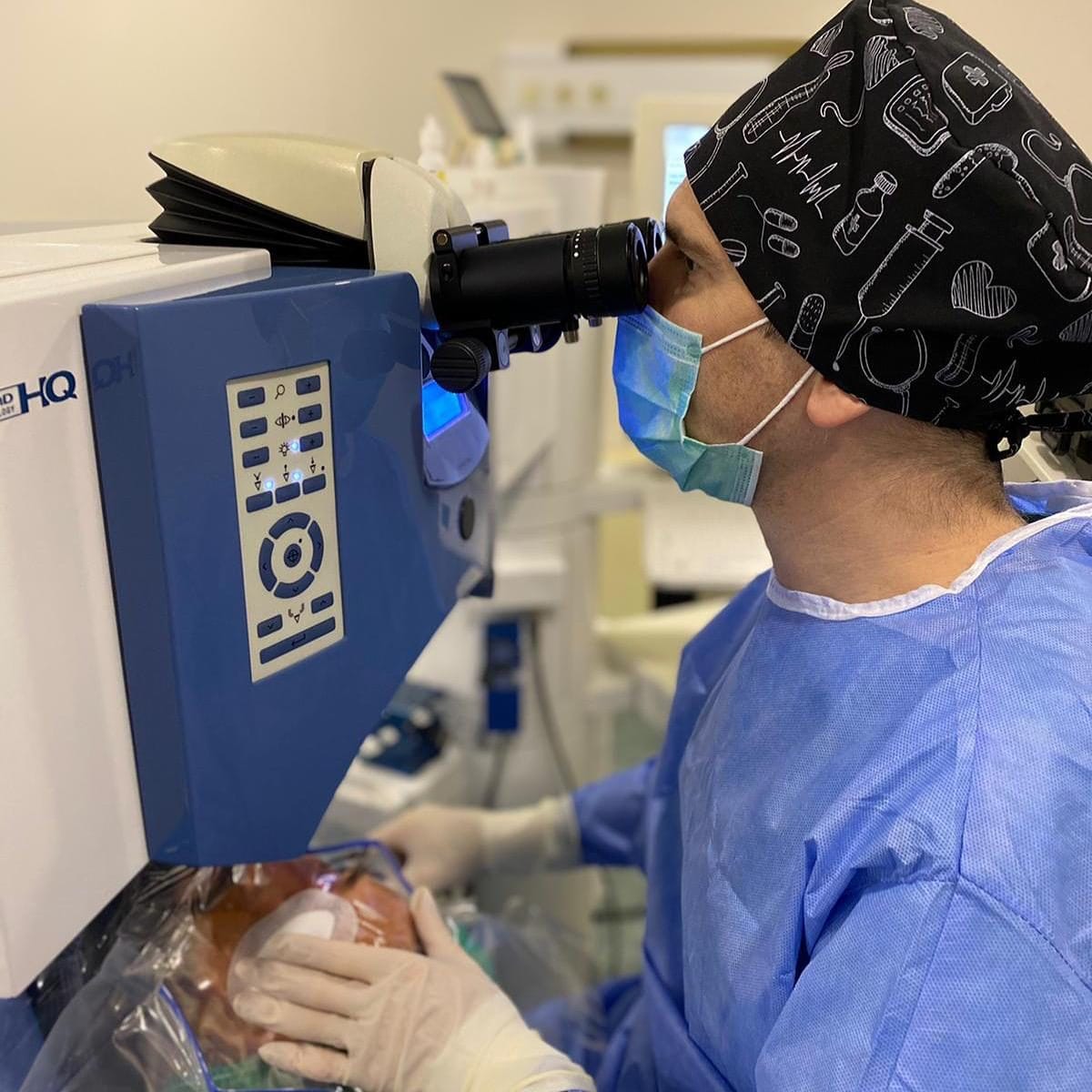
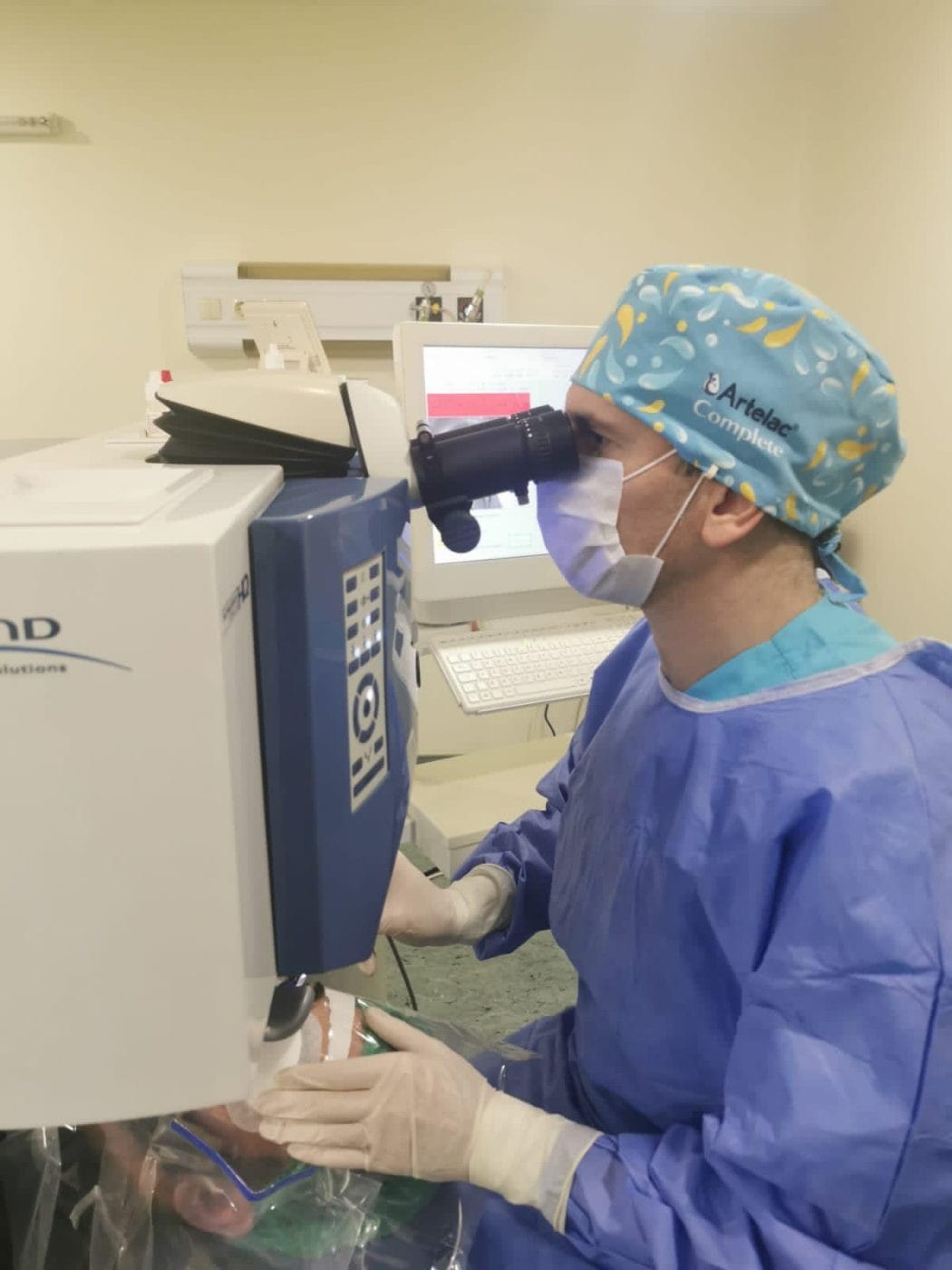
No Touch laser (TransPRK) is a treatment that uses only the excimer laser. In a single step, it reshapes the surface layer of the eye and the corneal tissue that corrects the prescription. During the treatment, no instrument touches the eye, and the laser creates no flap. The surface layer then usually heals within 2–4 days.
What is No Touch laser?
No Touch laser (TransPRK) is a surface laser treatment in which the excimer laser alone reshapes the surface layer of the eye (epithelium) and the underlying corneal tissue in a single step. We perform the procedure without any instrument touching the eye and without alcohol — hence its name. Because the treatment creates no flap, it preserves the structural integrity of the cornea.
How does No Touch laser work?
- Anaesthesia: First, drops numb the eye.
- Eye tracking: During treatment, the laser tracks small eye movements at high speed.
- Single-step treatment: The excimer laser first removes the surface layer and then reshapes enough tissue to correct the prescription, all in one go. The procedure takes only seconds per eye.
- Protective lens: Finally, the surgeon places a clear protective (bandage) contact lens on the eye until the surface layer has healed.
Step-by-step illustration of No Touch (T-PRK)
A single-step surface laser treatment in which no instrument touches the eye.
- Laser removal of the epitheliumThe excimer laser first removes the surface layer (epithelium), without any instrument touching the eye.
- Reshaping the corneaIn the same step, the laser reshapes enough stromal tissue to correct the prescription.
- Protective lensA clear bandage contact lens is placed on the eye until the surface has healed.
- Epithelial healingThe surface layer closes again within 2–4 days, and the cornea heals in its new shape.
Who is No Touch laser suitable for?
- People with thin corneas: Because there is no flap, the treatment preserves more corneal tissue.
- Contact sports and occupations with a risk of trauma: Such as boxing, martial arts, military and police personnel; there is no risk of flap displacement.
- Myopia, hyperopia and astigmatism: We can also use it across a wide range of prescriptions in suitable corneas.
- In combination with keratoconus treatment: In selected patients, we can combine it with cross-linking (combined CXL and No Touch).
- Age: At least 18; the most suitable period is usually between 18 and 40.
- Stable prescription: Your prescription should not have changed significantly (by more than 0.5 dioptres) in the past year.
- Healthy cornea: Corneal mapping (topography/tomography) and thickness measurements must be normal, and the tests must rule out keratoconus.
- General health: We do not perform surgery during pregnancy or breastfeeding, and we carefully assess uncontrolled diabetes and certain rheumatic and immune disorders.
- Eye health: We treat significant dry eye, blepharitis or intraocular disease first.
Recovery after No Touch
| Time | What to expect |
|---|---|
| Days 1–3 | Burning, grittiness, watering and light sensitivity may occur; controlled with painkillers and drops |
| Days 3–4 | The surface layer has closed in most patients; we remove the protective lens |
| Week 1 | Return to daily life and desk work |
| Months 1–3 | Visual clarity improves and stabilises |
Randomised studies have shown that the surface layer closes within 2–4 days on average. Discomfort in the first days varies from person to person. It would not be accurate to call the procedure “painless”; however, appropriate drops and medication control the discomfort well. With surface treatments, protection from sunlight and regular use of drops are important in order to reduce the risk of corneal haze.
No Touch laser outcomes
Meta-analyses have reported that the visual outcomes of single-step TransPRK are similar to those of conventional PRK, with possible advantages in secondary outcomes such as healing and procedure time. In addition, a meta-analysis of studies using the same laser platform found an efficacy of 94% and a rate of achieving the target refraction of 89%.
Prof. Dr. Fırat Helvacıoğlu and his team presented the visual, refractive, topographic and wavefront outcomes of TransPRK in virgin eyes at the 37th ESCRS Congress (Paris, 2019) and the 53rd National Congress of the Turkish Ophthalmological Association (2019). For corneal wavefront-guided TransPRK + CXL in keratoconus, see: Hybrid treatment for keratoconus.
No Touch or SMILE Pro?
Neither method involves a flap. No Touch has advantages for thin corneas, contact sports and hyperopia, but discomfort in the first days and the recovery period are longer. On the other hand, SMILE Pro offers a more comfortable and faster recovery for myopia and astigmatism. Your corneal measurements determine which is right for you.
No Touch laser cost and information for international patients
We determine the cost after the examination, depending on whether we treat one or both eyes. Laser vision correction is an elective procedure, and health insurance generally does not cover it. For international patients: the surface layer takes a few days to heal, and we remove the bandage lens on day 3–4. For this reason, we recommend staying in Istanbul for about 5–7 days. Consultations are also available in English.
Frequently asked questions
You feel no pain during the procedure. Until the surface layer heals, burning, grittiness and watering may occur for the first 2–3 days; we manage this period with drops and painkillers.
The surface layer usually closes in 3–4 days. Most patients can then return to desk work within 4–7 days.
Laser alone is not a treatment for keratoconus. However, in selected patients, we can combine a personalised No Touch treatment with cross-linking, which strengthens the cornea.
Visual outcomes are similar. Because there is no flap, No Touch has advantages in thin corneas and where there is a risk of trauma; with LASIK, vision clears more quickly and there is less discomfort in the first days.
Once your visual acuity is sufficient and your doctor clears you at a follow-up examination; usually within one week.
References
- Serfözö et al. Transepithelial versus conventional PRK: systematic review and meta-analysis. J Cataract Refract Surg. 2025. doi:10.1097/j.jcrs.0000000000001749
- Hashemi H et al. Transepithelial PRK versus mechanical and alcohol-assisted PRK: randomized trial. BMC Ophthalmol. 2022. doi:10.1186/s12886-022-02293-2
- Sabau A et al. Efficacy, safety, and predictability of transepithelial PRK with the Amaris excimer laser: meta-analysis. J Cataract Refract Surg. 2021. doi:10.1097/j.jcrs.0000000000000487
- Wen D et al. Postoperative efficacy, predictability, safety, and visual quality of laser corneal refractive surgery: a network meta-analysis. Am J Ophthalmol. 2017;178:65–78. doi:10.1016/j.ajo.2017.03.013
- Santhiago MR et al. Association between the percent tissue altered and post-laser in situ keratomileusis ectasia in eyes with normal preoperative topography. Am J Ophthalmol. 2014;158(1):87–95. doi:10.1016/j.ajo.2014.04.002
This page is intended for patient information and does not replace an examination or medical assessment. The treatment that is right for you is determined after an eye examination and measurements.
Book a No Touch laser suitability assessment
Prof. Dr. Fırat Helvacıoğlu · Veni Vidi Eye Clinic, Bağdat Caddesi No: 257, Caddebostan – Kadıköy, Istanbul, Türkiye