Strabismus Surgery
Childhood and adult strabismus · Lazy eye (amblyopia) · Prof. Dr. Fırat Helvacıoğlu, FEBOS-CR · Veni Vidi Eye Clinic, Caddebostan – Kadıköy, Istanbul
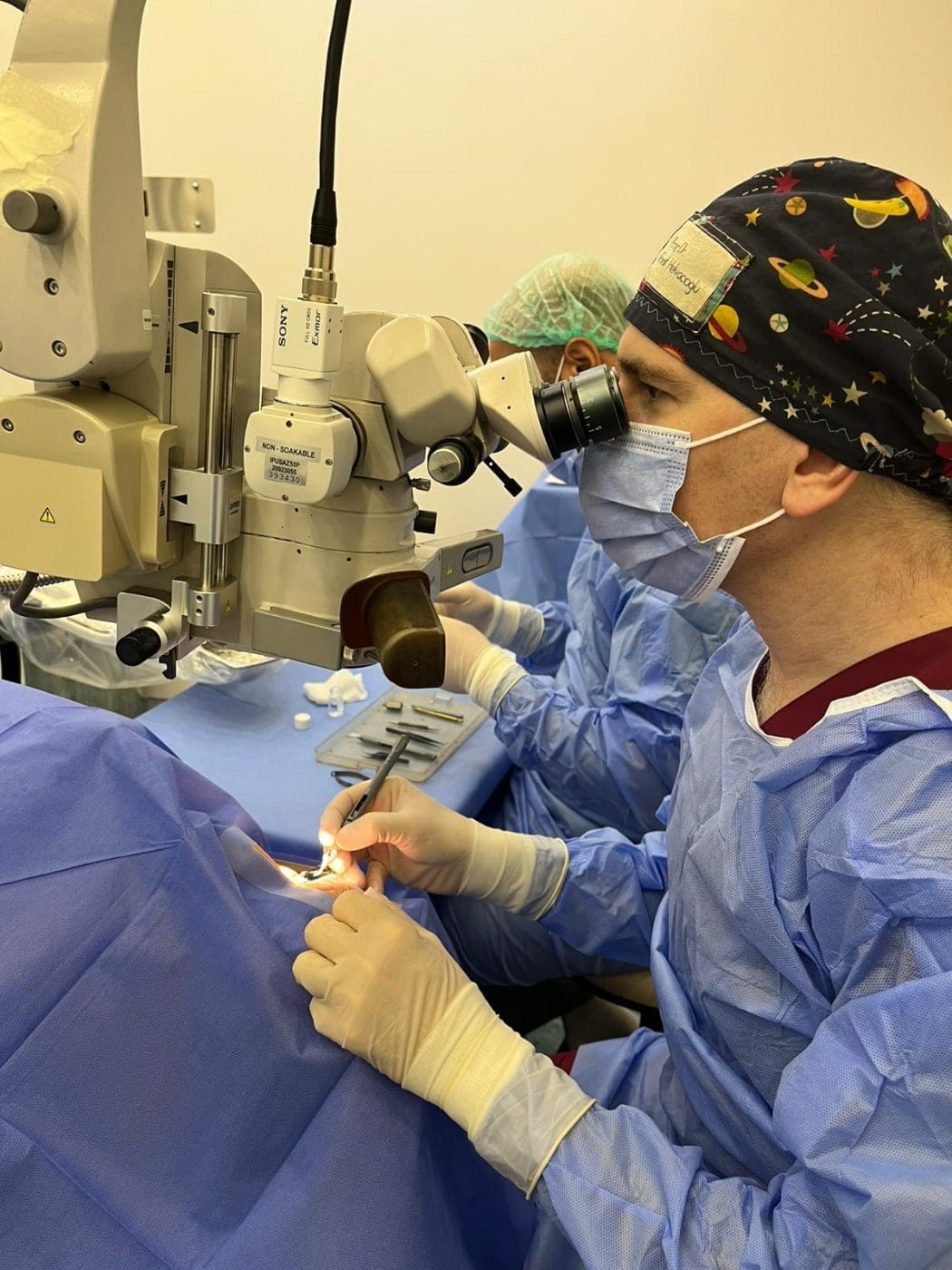
Strabismus (squint) is the inability of both eyes to look at the same point, because one eye turns inwards, outwards, upwards or downwards. It affects about 2% of the population. In children it can lead to a lazy eye, and in adults to double vision. Treatment includes glasses, patching and, when necessary, strabismus surgery on the external muscles of the eye. During surgery, the surgeon does not remove the eye from its socket.
Strabismus surgery in brief
- Affects about 2% of the population.
- Can lead to a lazy eye in children; any eye turn persisting beyond 4–6 months of age needs an examination.
- The surgeon does not remove the eye during surgery but adjusts the external eye muscles.
- Adult strabismus surgery can eliminate double vision and improve quality of life.
What is strabismus?
Strabismus is the inability of both eyes to look at the same point — that is, one eye turns inwards, outwards, upwards or downwards. It may be constant or intermittent, appearing only when tired, looking into the distance or daydreaming. According to a meta-analysis of 229,000 people, strabismus affects about 2% of the population. An outward turn (exotropia) is more common than an inward turn (esotropia).
How does the surgeon perform strabismus surgery?
Shows the correction made to the eye muscles, step by step.
- Straight gazeIn healthy eyes, both eyes look at the same point; the light reflex is at the centre of the pupil in both eyes.
- Strabismus (exotropia example)One eye may turn inwards (esotropia), outwards (exotropia), upwards or downwards; in children this can lead to a lazy eye.
- Muscle surgery (recession)The surgeon restores balance by moving the insertion of the muscle that pulls the eye outwards back by a measured amount (recession). Alternatively, the surgeon shortens a muscle.
- ResultThe eyes become aligned. The surgeon does not remove the eye from its socket but operates on the external muscles of the eye.
Strabismus surgery and lazy eye in children
The most important consequence of strabismus in children is lazy eye (amblyopia), which develops when the brain suppresses the image from the deviating eye. In addition, amblyopia affects about 1.75% of children worldwide and can become permanent if not treated at an early age.
- Occasional eye turns in the first months of life can be normal in newborns. However, any turn persisting beyond 4–6 months of age needs evaluation.
- Glasses alone correct some inward turns caused by hyperopia (accommodative esotropia).
- If there is a lazy eye, we first use glasses and patching (covering the good eye). Then we plan surgery if needed.
- We advise all children to have at least one comprehensive eye examination before starting school.
Strabismus surgery in adults
In adults, strabismus may be a residual childhood squint. It may also follow nerve palsies (diabetes, hypertension, trauma), thyroid eye disease or previous eye surgery. New-onset deviations often cause double vision, so the doctor should investigate the underlying cause. Adult strabismus surgery is not purely cosmetic. It can eliminate double vision, expand the field of vision and have a positive effect on self-confidence and social life. In a study of 79 adults with childhood-onset strabismus, persistent double vision after surgery was rare (1–2%). Also, quality of life scores rose markedly within one year.
Strabismus surgery and other treatment options
- Glasses: The first treatment, particularly for inward turns caused by hyperopia.
- Patching and amblyopia treatment: To equalise vision in children.
- Prism glasses: For small deviations and double vision.
- Botulinum toxin: To temporarily relax the relevant muscle in selected cases.
- Strabismus surgery: The surgeon moves the insertion of the external muscles that move the eye back by a measured amount (recession) or shortens the muscle (resection/plication). The surgeon does not remove the eye from its socket. The incision in the membrane over the white of the eye leaves no visible scar. We use general anaesthesia in children and local anaesthesia in suitable adults. The adjustable suture technique allows fine-tuning after surgery in selected adults.
Redness and grittiness occur for a few days after surgery; most patients return to daily life within a few days. Some patients may need a second operation.
Prof. Dr. Fırat Helvacıoğlu’s research on strabismus
Research
Prof. Dr. Fırat Helvacıoğlu published the results of applying amniotic membrane around the muscles in patients requiring repeat strabismus surgery and with restrictive strabismus due to adhesions in the Japanese Journal of Ophthalmology (2013). In this prospective study, the mean deviation decreased from 34.3 to 4.6 prism dioptres. In addition, 86% of patients achieved a deviation of less than 8 prism dioptres with full eye movement. He has also given national congress presentations on the clinical features of paralytic strabismus, strabismus surgery outcomes, congenital esotropia and the use of amniotic membrane in double elevator palsy.
Frequently asked questions
There is no age limit. For congenital inward turns, surgeons usually operate at an early age. For other types, timing depends on the size of the deviation, vision and amblyopia treatment. Surgeons also perform it successfully in adults.
No. The surgeon operates on the external muscles through the thin membrane over the white of the eye and does not remove the eye from its socket.
If you have a refractive error, you will need to continue wearing glasses. Glasses may be part of the treatment of strabismus.
Apart from temporary eye turns in the first months of life, strabismus usually does not resolve on its own. Early examination is important to prevent a lazy eye in children.
Yes. Adult strabismus surgery can eliminate double vision, expand the field of vision and markedly improve psychosocial well-being.
References
- Hashemi H et al. Global and regional prevalence of strabismus: a comprehensive systematic review and meta-analysis. Strabismus. 2019;27(2):54–65. doi:10.1080/09273972.2019.1604773
- Hashemi H et al. Global and regional estimates of prevalence of amblyopia: a systematic review and meta-analysis. Strabismus. 2018;26(4):168–183. doi:10.1080/09273972.2018.1500618
- Wang JY et al. Diplopia after strabismus surgery for adults with nondiplopic childhood-onset strabismus. J AAPOS. 2019;23(6):313.e1–313.e5. doi:10.1016/j.jaapos.2019.07.005
- Hassan S et al. Adjustable versus non-adjustable sutures for strabismus. Cochrane Database Syst Rev. 2018;3(3):CD004240. doi:10.1002/14651858.CD004240.pub4
- Tuğcu B, Helvacıoğlu F, Yüzbaşıoğlu E, Gürez C, Yiğit U. Amniotic membrane in the management of strabismus reoperations. Jpn J Ophthalmol. 2013;57(2):239–244. doi:10.1007/s10384-012-0217-5
This page offers patient information and does not replace an examination or medical assessment. We determine the treatment that is right for you after an eye examination and measurements.
Strabismus and lazy eye examination
Prof. Dr. Fırat Helvacıoğlu · Veni Vidi Eye Clinic, Bağdat Caddesi No: 257, Caddebostan – Kadıköy, Istanbul, Türkiye
Related pages
- Comprehensive Eye ExaminationWho needs an eye examination and how often, what a comprehensive eye exam involves, and which symptoms need urgent care. Veni Vidi Eye Clinic, Istanbul.
- Refractive Errors and Their TreatmentRefractive errors – myopia, hyperopia, astigmatism, presbyopia: how the prescription is measured and treated with glasses, lenses, laser, ICL or smart lens.
- Eye Diseases and TreatmentsGlaucoma, dry eye, blepharitis, pterygium, corneal diseases, tear duct obstruction, strabismus and eyelid surgery in Istanbul. Diagnosis and treatment.