
PRK Laser
Photorefractive keratectomy – flapless surface laser · Prof. Dr. Fırat Helvacıoğlu, FEBOS-CR · Veni Vidi Eye Clinic, Caddebostan – Kadıköy, Istanbul
PRK (photorefractive keratectomy) is a flapless laser treatment: the surgeon removes the surface layer of the cornea and reshapes the underlying tissue with the excimer laser. It corrects myopia, hyperopia and astigmatism and is particularly suitable for people with thin corneas and those at risk of eye trauma. The surface layer heals in 3–5 days.
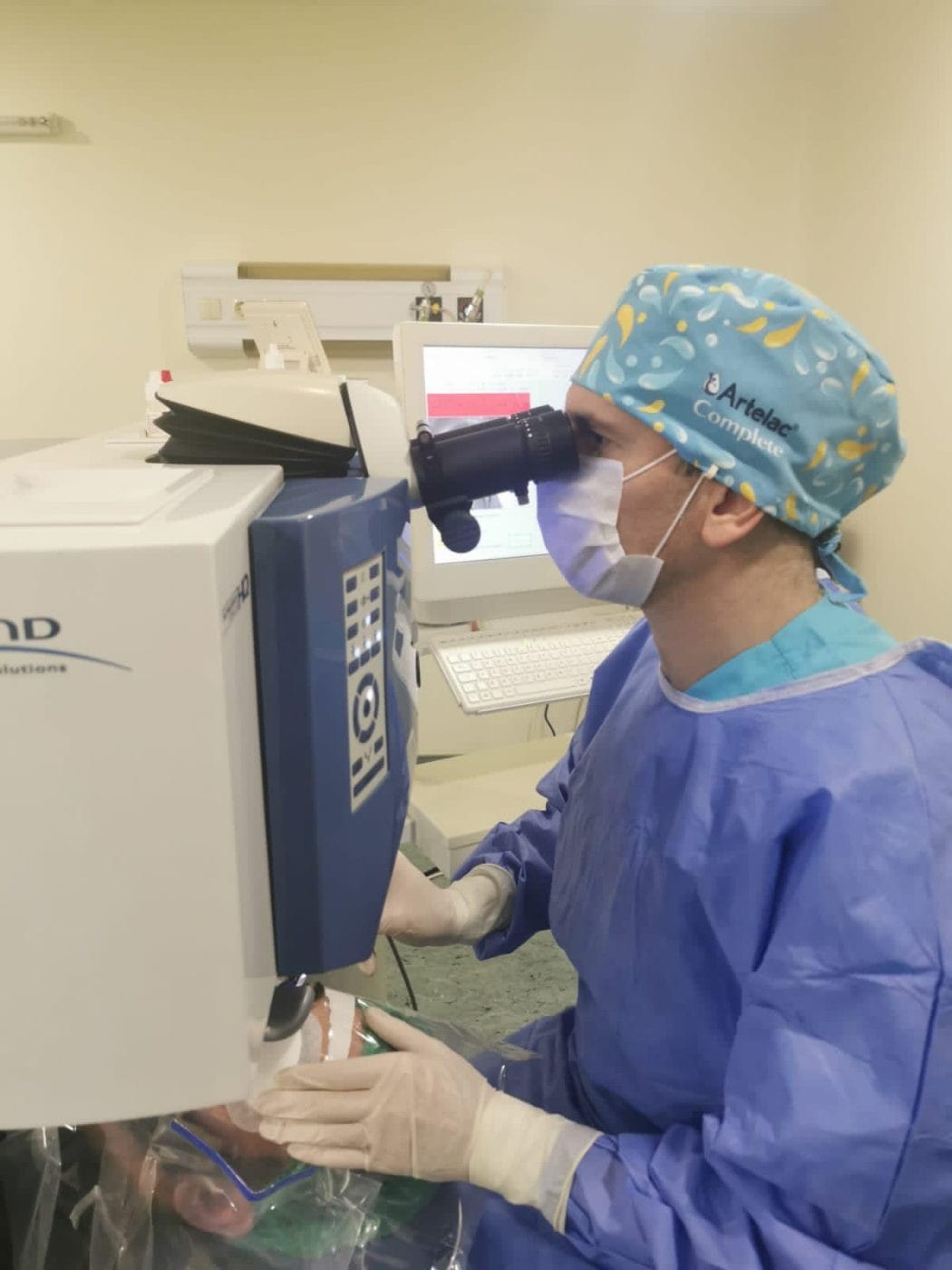
What is PRK laser?
PRK (photorefractive keratectomy) is a surface laser treatment that corrects myopia, hyperopia and astigmatism by removing the surface layer of the cornea (epithelium) and then reshaping the underlying tissue with the excimer laser. The surgeon creates no corneal flap. Performed since the late 1980s, PRK is the original laser eye procedure and has the longest follow-up data.
In conventional PRK, the surface layer is first softened with dilute alcohol and then gently removed with a special instrument. The laser also removes this layer in a single step, without any instrument touching the eye, in the technique called No Touch laser (TransPRK). In both techniques, the excimer laser corrects the prescription in the same way.
How does PRK surgery work?
- Anaesthesia: First, drops numb the eye; we do not put the patient to sleep, and the patient feels no pain.
- Removing the surface layer: The surgeon softens the thin outermost layer of the cornea (epithelium) with dilute alcohol and gently removes it with a special instrument.
- Excimer laser: Tracking small eye movements, the laser reshapes enough tissue to correct the prescription within seconds. Then the surgeon applies mitomycin C briefly to prevent corneal haze.
- Protective lens: The surgeon places a clear bandage contact lens on the eye until the surface layer has healed. The whole procedure for both eyes usually takes 15–20 minutes.
Step-by-step illustration of the procedure
Conventional surface laser in which the surgeon removes the surface layer with an instrument.
- Removing the epitheliumDrops numb the eye; the surgeon softens the surface layer (epithelium) with dilute alcohol and gently removes it with a special instrument.
- Excimer laserThe excimer laser reshapes the exposed corneal tissue to correct the prescription.
- Protective lensThe surgeon places a clear bandage contact lens on the eye until the surface has healed.
- Epithelial healingThe surface layer closes again within a few days; vision sharpens over the following weeks.
Who is PRK suitable for?
- People with thin corneas: Because the surgeon creates no flap, more corneal tissue stays intact.
- Contact sports and occupations with a risk of trauma: Such as boxing, martial arts, military and police personnel; there is no risk of flap displacement.
- Irregularities of the corneal surface: Certain situations in which LASIK is unsuitable, such as epithelial disorders or superficial scars.
- Some patients who have had LASIK and need an enhancement: Surgeons may prefer surface treatment when re-lifting the flap is undesirable.
- Small residual prescriptions after smart lens surgery: Also, PRK can correct small residual refractive errors after multifocal or trifocal lens surgery. Prof. Dr. Fırat Helvacıoğlu presented the results of this “fine-tuning” treatment at the 36th ESCRS Congress (Vienna, 2018).
- Age: At least 18; the most suitable period is usually between 18 and 40.
- Stable prescription: Your prescription should not have changed significantly (by more than 0.5 dioptres) in the past year.
- Healthy cornea: Corneal mapping (topography/tomography) and thickness measurements must be normal, and the surgeon must rule out keratoconus.
- General health: We do not perform surgery during pregnancy or breastfeeding; we assess uncontrolled diabetes and certain rheumatic and immune disorders carefully.
- Eye health: We treat significant dry eye, blepharitis or intraocular disease first.
Corneal haze and mitomycin C
After surface laser treatment, a mild clouding of the cornea (haze) can rarely develop as the cornea heals; the risk increases with the amount of correction. According to a literature assessment by the American Academy of Ophthalmology (AAO), mitomycin C applied briefly during surgery, at an appropriate dose and only to the centre of the cornea, reduces the development of haze, particularly in high myopia treatments. Prof. Dr. Fırat Helvacıoğlu uses mitomycin C in PRK treatments and presented his experience with haze after excimer laser surgery at the SCHWIND User Meeting (Istanbul, 2016).
Protecting the eyes from sunlight after surgery (UV-protective sunglasses) and using the recommended drops regularly also reduce the risk of haze.
Recovery after PRK
| Time | What to expect |
|---|---|
| Days 1–3 | Burning, grittiness, watering and light sensitivity may occur; controlled with painkillers and drops |
| Days 3–5 | The surface layer has closed in most patients; we remove the protective lens |
| Week 1 | Return to daily life and desk work |
| Months 1–3 | Visual clarity improves and stabilises |
With PRK, vision clears more slowly than with flap-based methods (LASIK) and discomfort in the first days is more pronounced, but appropriate drops and medication control it well. There is no significant difference between the methods in terms of the final result.
PRK outcomes: the scientific evidence
A Cochrane review comparing LASIK and PRK reported faster visual recovery and less pain in the first days with LASIK, while long-term visual outcomes were similar with both methods.
PRK is the laser method with the longest follow-up. In a 20-year study from Türkiye, best spectacle-corrected vision was 20/20 or better in all treated eyes, and the study showed that the corneal tissue had preserved its healthy structure. Another 20-year study from Italy found no late sight-threatening complications such as ectasia or haze.
PRK, No Touch or LASIK?
| Feature | PRK | No Touch (TransPRK) | LASIK (Q-LASIK, Femto-LASIK) |
|---|---|---|---|
| Flap | No | No | Yes |
| Surface layer | The surgeon softens it with alcohol and removes it with an instrument | The laser removes it in a single step | The surgeon preserves it and lifts a flap |
| Discomfort in the first days | Noticeable | Noticeable | Mild |
| Visual recovery | Days to weeks | Days to weeks | Hours to 1 day |
| Particularly suitable for | Thin corneas, risk of trauma | Thin corneas, risk of trauma | Those wanting rapid recovery, adequate corneal thickness |
Other methods: No Touch · SMILE Pro · Q-LASIK · Femto-LASIK
Risks and possible complications
- Pain and light sensitivity in the first days: These last until the surface layer has healed.
- Corneal haze: Rare; mitomycin C and sun protection reduce the risk.
- Delayed epithelial healing: Rare; monitored at follow-up visits.
- Dry eye and halos at night: Usually temporary.
- Infection: Very rare; following the drop regimen and hygiene rules while the protective lens is in place is important.
- Regression: A small number of patients may develop a minor prescription over time; if the cornea is suitable, we can perform an enhancement.
Cost and information for international patients
We determine the cost after the examination, depending on whether we treat one or both eyes. Laser vision correction is an elective procedure, and health insurance generally does not cover it. For international patients: because the surface layer takes several days to heal and we remove the bandage lens on day 3–5, we recommend staying in Istanbul for about one week. Consultations are available in English.
Frequently asked questions
You feel no pain during the procedure. Until the surface layer heals, burning, grittiness and watering may occur for the first 2–3 days; we control this period with drops and painkillers.
Both are flapless surface treatments. In PRK, the surgeon softens the surface layer with alcohol and removes it with a special instrument; in No Touch, the laser also removes this layer in a single step, without any instrument touching the eye.
The surface layer usually closes in 3–5 days. Most patients can return to desk work within about one week.
Long-term visual outcomes are similar. Because there is no flap, PRK has advantages in thin corneas and where there is a risk of trauma; with LASIK, vision clears more quickly and there is less discomfort in the first days.
Once your visual acuity is sufficient and we have cleared you at a follow-up examination; usually within 1–2 weeks.
Yes, but we recommend wearing UV-protective sunglasses during the first months to reduce the risk of corneal haze.
References
- Shortt AJ, Allan BD, Evans JR. Laser-assisted in-situ keratomileusis (LASIK) versus photorefractive keratectomy (PRK) for myopia. Cochrane Database Syst Rev. 2013;(1):CD005135. doi:10.1002/14651858.CD005135.pub3
- Majmudar PA et al. Mitomycin-C in corneal surface excimer laser ablation techniques: a report by the American Academy of Ophthalmology. Ophthalmology. 2015;122(6):1085–1095. doi:10.1016/j.ophtha.2015.01.019
- Bilgihan K et al. Evaluation of long-term corneal morphology after photorefractive keratectomy by in vivo confocal microscopy and specular microscopy; 20-year follow-up. Eye Contact Lens. 2019;45(6):360–364. doi:10.1097/ICL.0000000000000585
- Cennamo G et al. Twenty-year follow-up of excimer laser photorefractive keratectomy: a retrospective observational study. Ophthalmol Ther. 2020;9(4):917–927. doi:10.1007/s40123-020-00281-7
- Serfözö et al. Transepithelial versus conventional PRK: systematic review and meta-analysis. J Cataract Refract Surg. 2025. doi:10.1097/j.jcrs.0000000000001749
- Wen D et al. Postoperative efficacy, predictability, safety, and visual quality of laser corneal refractive surgery: a network meta-analysis. Am J Ophthalmol. 2017;178:65–78. doi:10.1016/j.ajo.2017.03.013
This page offers patient information and does not replace an examination or medical assessment. Finally, we determine the treatment that is right for you after an eye examination and measurements.
Book a PRK suitability assessment
Prof. Dr. Fırat Helvacıoğlu · Veni Vidi Eye Clinic, Bağdat Caddesi No: 257, Caddebostan – Kadıköy, Istanbul, Türkiye