
Phakic Intraocular Lens (ICL)
A lens that corrects high prescriptions while preserving the natural lens · Prof. Dr. Fırat Helvacıoğlu, FEBOS-CR · Veni Vidi Eye Clinic, Caddebostan – Kadıköy, Istanbul
An ICL (phakic intraocular lens) is a thin, flexible lens that sits between the iris and the natural lens. The natural lens stays in place. The ICL corrects myopia, hyperopia and astigmatism without removing corneal tissue. Surgeons prefer it particularly for people whose prescription is too high for laser correction or whose cornea is unsuitable. If necessary, the surgeon can remove it.
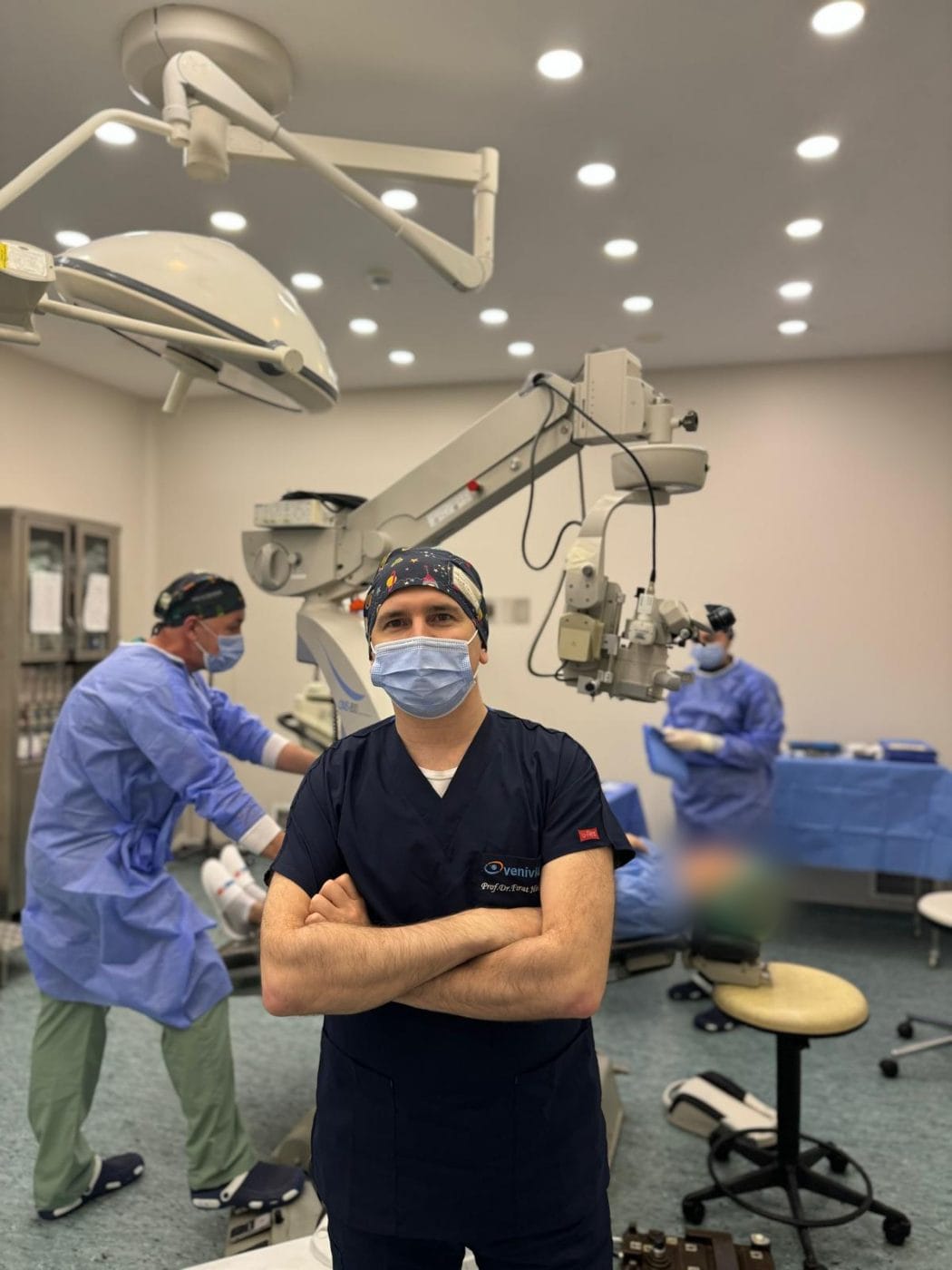
What is a phakic intraocular lens (ICL)?
A phakic intraocular lens (ICL – Implantable Collamer Lens) is a thin, flexible lens that corrects myopia, hyperopia and astigmatism. It sits between the iris and the eye’s natural lens, which stays in place. “Phakic” means that the eye keeps its natural lens. An ICL does not remove any corneal tissue. This makes it a leading option when the prescription is too high for laser treatment or the cornea is unsuitable.
The lens consists of a soft, collagen-containing material (Collamer) that is biocompatible with the eye’s tissues. You also cannot feel it inside the eye. Unlike a contact lens, you do not insert and remove it. It stays in place permanently, but a surgeon can remove or exchange it if necessary. Current ICLs have a small central port that allows the flow of aqueous fluid inside the eye. Thanks to this design, you generally no longer need the laser iridotomy that used to be necessary before surgery.
Who is an ICL suitable for?
- High myopia: Prescriptions beyond the safe limits of laser treatment.
- People whose cornea is unsuitable for laser: We do not recommend laser eye surgery for some people. Reasons include a thin cornea, suspicious findings on corneal topography or significant dry eye.
- Hyperopia and astigmatism: In selected patients, the ICL can also correct hyperopia, and a toric ICL can correct astigmatism.
- Young adults with a stable prescription: Usually people aged 21–45 whose prescription has not changed for at least a year. In addition, their natural lens is clear.
- Stable keratoconus: We may consider a toric ICL in some keratoconus patients. This applies when cross-linking has halted the disease or when it is not progressing.
ICL, laser or smart lens?
| Feature | ICL (phakic intraocular lens) | Laser (SMILE Pro, Femto-LASIK, No Touch) | Refractive lens exchange |
|---|---|---|---|
| Where does the treatment take place? | Inside the eye; the natural lens remains in place | On the cornea | Inside the eye; the surgeon removes the natural lens |
| Does it remove tissue? | No | Yes, from the cornea | It removes the natural lens |
| Is it reversible? | Yes, the surgeon can remove the lens | No | The surgeon can exchange the lens |
| Suitable for | High prescriptions, thin/unsuitable cornea, young adults | Suitable cornea, prescription within laser limits | Usually over 45, with presbyopia |
| Near vision | Because the natural lens remains, near vision continues to decline with age | Same | A smart lens also targets near vision |
We decide on the suitable method at the consultation. The decision depends on your prescription, corneal thickness and topography, anterior chamber depth, age and eye health.
How does ICL surgery work?
- Detailed measurements: We measure anterior chamber depth, endothelial cell count, the internal diameter of the eye and corneal parameters. We then select the ICL for each eye according to these measurements and the prescription. Correctly determining the lens size is the most critical step of the procedure.
- Surgery: Performed under topical anaesthesia. The surgeon inserts the folded lens through a small incision of about 3 mm. The lens then unfolds inside the eye, and the surgeon positions it behind the iris. The procedure usually takes 15–20 minutes per eye; no stitches are necessary.
- Home the same day: The patient goes home a few hours later. We can operate on both eyes on the same day or a few days apart.
Recovery after surgery
In most patients, vision clears markedly within the first few hours. Many can return to daily activities the next day. Mild grittiness, light sensitivity and halos around lights at night may occur in the first days. You use drops for a few weeks. Avoid pressing or rubbing the eye, as well as environments such as swimming pools and the sea. At follow-up visits, we assess eye pressure and the position of the lens. We also check the space between the ICL and the natural lens (vault).
ICL outcomes and safety: the scientific evidence
A meta-analysis of 27 studies (2,204 eyes) examined current central-port ICLs. In this analysis, 80% of patients achieved uncorrected vision of 20/20 or better. In addition, 87% of eyes were within ±0.50 dioptres of the target refraction. Eye pressure remained stable after surgery, and the studies reported no sight-threatening complications.
A Cochrane review compared laser surgery with phakic intraocular lenses for moderate to high myopia. With phakic lenses, it found a lower risk of losing best spectacle-corrected vision, and patients also preferred them. A network meta-analysis compared different methods. In this comparison, the ICL also had the fewest higher-order optical aberrations affecting post-operative visual quality.
Long-term data are also favourable. At 10-year follow-up, endothelial cell loss remained at about 4%, with no pigment dispersion glaucoma or sight-threatening complications. Another 8-year study likewise found no significant rise in eye pressure or endothelial loss.
Prof. Dr. Fırat Helvacıoğlu and his team presented the early results of a newly developed posterior chamber phakic intraocular lens in high myopia at the 37th ESCRS Congress (Paris, 2019) and the 53rd National Congress of the Turkish Ophthalmological Association (2019).
What are the possible risks?
The ICL is a safe operation. However, as with any intraocular surgery, it carries risks that patients should be aware of:
- Lens size and vault: Too little or too much space between the ICL and the natural lens is the most common issue. If necessary, the surgeon exchanges the lens for one of a different size.
- Eye pressure: A temporary rise in pressure may occur in the early period. We therefore monitor and treat it at follow-up visits.
- Cataract: Cataract formation is rare with current central-port lenses. If a cataract develops later in life, the surgeon can remove the ICL and perform cataract surgery.
- Halos and glare: You may notice these, especially at night; they usually diminish over time.
- Infection: Very rare; sterile conditions and post-operative drops minimise the risk.
Regular post-operative check-ups (endothelial cell count, eye pressure, vault) are important for long-term safety.
Cost and information for international patients
We finalise the cost of ICL surgery after the examination and measurements. We select the lens to match your individual measurements and prescription. The cost therefore depends on the lens type (spherical or toric ICL) and whether we treat one or both eyes.
For international patients: Please note that the manufacturer makes each ICL to order for the individual eye. We therefore need detailed measurements before we can order the lens. Send us your eye reports by WhatsApp for a preliminary assessment and quote. We then arrange the exact plan and length of stay in Istanbul individually. Consultations are also available in English.
Frequently asked questions
An ICL is a thin, flexible intraocular lens that corrects myopia, hyperopia and astigmatism. It sits between the iris and the natural lens, which stays in place. The procedure does not remove any corneal tissue.
Surgeons prefer ICLs particularly for high myopia beyond the safe limits of laser surgery. However, they are also an option for moderate prescriptions. Your eye measurements determine the exact limit.
Yes. An ICL stays in place permanently, but a surgeon can remove or exchange it if necessary. If a cataract develops later in life, the surgeon can remove the lens and perform cataract surgery.
For people with a suitable cornea and a prescription within laser limits, laser surgery is a good option. However, if the prescription is high or the cornea is unsuitable for laser, the ICL comes to the fore. The decision is based on the examination and measurements.
No. The lens sits behind the iris; it is not visible from the outside. You also cannot feel it, and it needs no maintenance.
This depends on your measurements and on whether we need to order the lens after your examination. We prepare your plan, including the length of stay, individually after reviewing your reports.
References
- Larivoir NB et al. Efficacy, predictability, and safety of phakic Implantable Collamer Lenses V4c and V5: a systematic review and meta-analysis. J Refract Surg. 2025;41(12):e1349–e1359. doi:10.3928/1081597X-20251010-01
- Barsam A, Allan BD. Excimer laser refractive surgery versus phakic intraocular lenses for the correction of moderate to high myopia. Cochrane Database Syst Rev. 2014;(6):CD007679. doi:10.1002/14651858.CD007679.pub4
- Chen T et al. Higher order aberrations and visual quality after refractive surgeries for myopia: a systematic review and network meta-analysis. Graefes Arch Clin Exp Ophthalmol. 2026. doi:10.1007/s00417-026-07386-y
- Alfonso-Bartolozzi B et al. Ten-year follow-up of posterior chamber phakic intraocular lens with central port design in patients with low and normal vault. J Cataract Refract Surg. 2024;50(5):441–447. doi:10.1097/j.jcrs.0000000000001379
- Kamiya K et al. Eight-year outcomes of implantation of posterior chamber phakic intraocular lens with a central port for moderate to high ametropia. Front Med (Lausanne). 2021;8:799078. doi:10.3389/fmed.2021.799078
- Alhamzah A et al. Indications for exchange or explantation of phakic implantable collamer lens with central port in patients with and without keratoconus. Int J Ophthalmol. 2021;14(11):1714–1720. doi:10.18240/ijo.2021.11.10
- Packer M. Meta-analysis and review: effectiveness, safety, and central port design of the intraocular collamer lens. Clin Ophthalmol. 2016;10:1059–1077. doi:10.2147/OPTH.S111620
- Yuzbasioglu E, Helvacioglu F, Sencan S. Fixed, dilated pupil after phakic intraocular lens implantation. Journal of Cataract and Refractive Surgery. 2006;32(1):174-176. doi:10.1016/j.jcrs.2005.11.016
This page provides information for patients and does not replace an examination or medical assessment. Your doctor determines the treatment that is right for you after an eye examination and measurements.
Book an ICL suitability assessment
Prof. Dr. Fırat Helvacıoğlu · Veni Vidi Eye Clinic, Bağdat Caddesi No: 257, Caddebostan – Kadıköy, Istanbul, Türkiye