
Toric Lens
Intraocular lens that corrects astigmatism · Prof. Dr. Fırat Helvacıoğlu, FEBOS-CR · Veni Vidi Eye Clinic, Caddebostan – Kadıköy, Istanbul
A toric lens is an intraocular lens that the surgeon implants during cataract or smart lens surgery to correct astigmatism. The surgeon aligns it with the axis of the corneal astigmatism, reducing the need for glasses after surgery. Toric versions of monofocal, EDOF and trifocal lenses are available.
What is a toric lens?
A toric lens is an intraocular lens that corrects astigmatism. It replaces the natural lens during cataract or smart lens surgery. Standard (spherical) intraocular lenses correct myopia and hyperopia but not astigmatism. A toric lens, by contrast, has different refractive power in different meridians. During surgery, the surgeon aligns this power with the axis of the corneal astigmatism to neutralise it.
Toric is a design feature rather than a lens type in its own right. There are toric versions of monofocal, EDOF and trifocal lenses. This allows us to target distance, intermediate and near vision while also correcting astigmatism in the same operation.
What is astigmatism, and why does it matter?
In astigmatism, the cornea (the clear front window of the eye) curves more steeply in one direction than the other. Light cannot focus at a single point. As a result, images may look blurred, shadowed or doubled, and lights scatter, especially at night. A significant proportion of cataract patients have corneal astigmatism at a level that needs correction at the time of surgery.
If astigmatism remains uncorrected during cataract surgery, you may still need glasses for distance vision. This is true even with a very accurate lens power calculation. With smart lenses, uncorrected astigmatism markedly reduces the visual quality the lens can provide.
Who is a toric lens suitable for?
- Cataract patients with regular corneal astigmatism: Those with significant regular astigmatism confirmed by measurements.
- Patients considering a smart lens: For the full benefit of a trifocal or EDOF lens, astigmatism correction is essential. We therefore use a toric smart lens in these patients.
- Candidates for refractive lens exchange: In refractive lens exchange, the goal is independence from glasses without a cataract. A toric lens also corrects astigmatism in these patients.
How do we plan toric lens surgery?
The success of toric lens surgery depends on the accuracy of the pre-operative measurements:
- Preparing the ocular surface: Dry eye can distort measurements. If necessary, we treat the ocular surface first and then repeat the measurements.
- Biometry and corneal topography: We measure the magnitude and axis of astigmatism with more than one device and compare the results.
- Posterior corneal astigmatism: Not only the front but also the back surface of the cornea contributes to total astigmatism. We take this effect into account when calculating the lens power.
- Calculating lens power and axis: Current toric formulas determine the spherical and cylindrical lens power and the implantation axis.
How does toric lens surgery work?
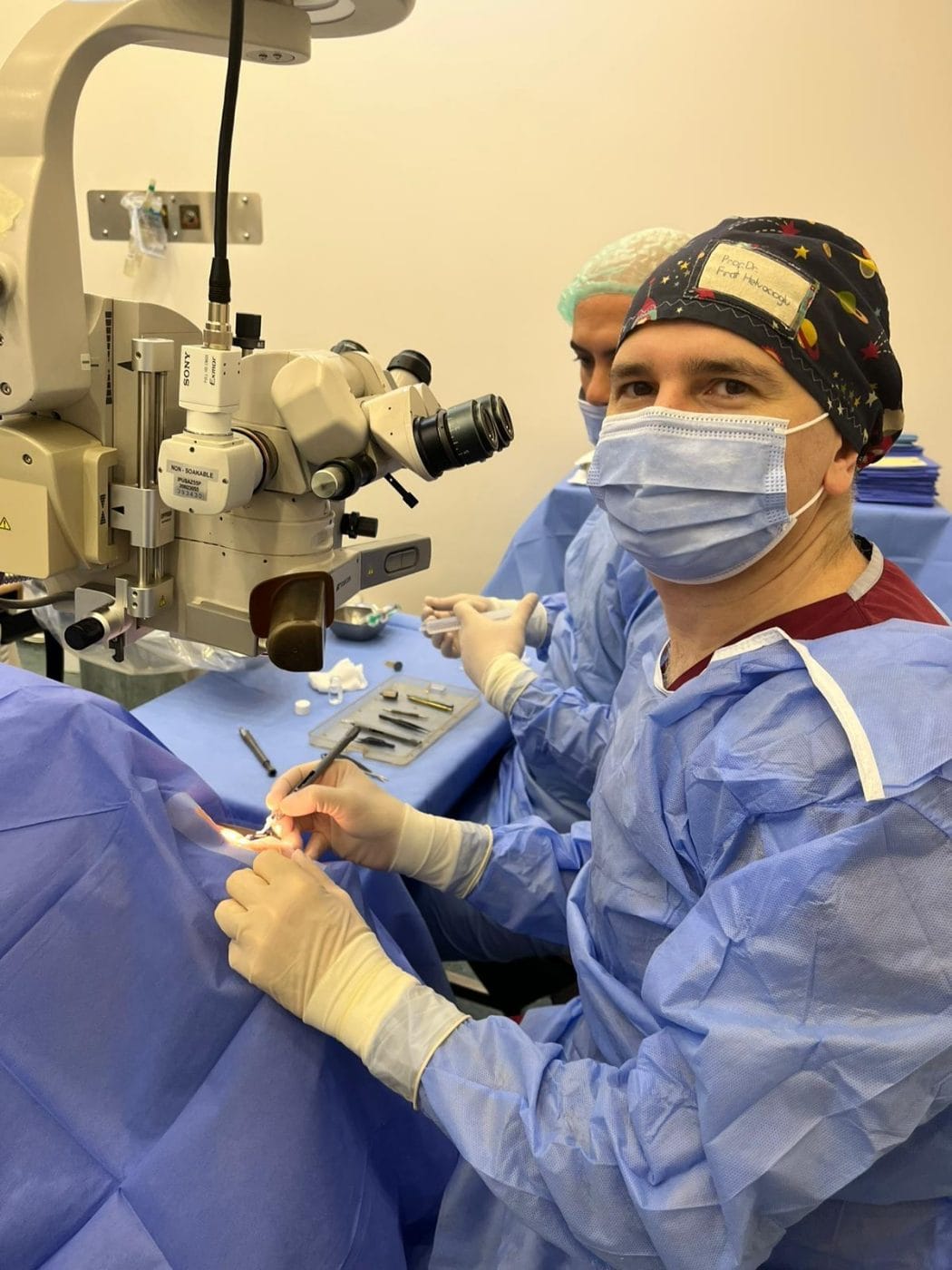
Like cataract surgery, the operation takes place under topical anaesthesia and usually lasts 15–20 minutes per eye. First, the surgeon removes the natural lens by phacoemulsification and places the new lens in the capsular bag. Then the surgeon aligns the axis marks on the lens with the planned astigmatism axis. Manual marking before surgery or digital (image-guided) marking during surgery can guide this alignment. Meta-analyses have shown that digital marking reduces alignment error.
Can a toric lens rotate?
The effect of a toric lens depends on it staying on the correct axis. Each degree of misalignment reduces the corrective effect by approximately 3%. At 30 degrees of misalignment, the correction disappears entirely. The rotational stability of the lens is therefore important.
A meta-analysis of 51 studies including 4,863 eyes found a mean rotation of about 2.4 degrees for current toric lenses. In other words, modern toric lenses are very stable. Rotation most often occurs in the first few days. In the rare event of significant rotation, a short procedure can reposition the lens to the correct axis.
Toric lens outcomes: the scientific evidence
A meta-analysis of 12 studies compared toric and non-toric lenses in cataract patients with corneal astigmatism. According to this analysis, toric lenses result in less residual astigmatism and better uncorrected distance vision. With toric lenses, the likelihood of residual astigmatism of 0.5 dioptres or less is about 3.3 times higher.
Toric lenses also compare favourably with methods that reduce astigmatism by incisions in the cornea. Compared with femtosecond laser–assisted astigmatic keratotomy (FSAK), toric lenses leave less residual astigmatism and give better uncorrected distance vision. A Cochrane review compared them with limbal relaxing incisions (LRI). It found a difference in favour of toric lenses, although it was small. For low levels of astigmatism, we may therefore also consider other options.
Cost and information for international patients
We finalise the cost of toric lens surgery after the examination. It depends on the type (toric monofocal, toric EDOF, toric trifocal) and on whether we treat one or both eyes.
For international patients: Send us your previous eye reports and topography by WhatsApp for a personalised treatment plan and quote. For surgery on both eyes, we recommend planning a stay of about one week in Istanbul. This also allows us to check the lens position after surgery. Consultations are available in English.
Frequently asked questions
It is an intraocular lens that the surgeon implants during cataract or smart lens surgery to correct astigmatism. Its refractive power differs between meridians, and the surgeon aligns the lens with the axis of the corneal astigmatism.
Yes. In patients with significant regular corneal astigmatism, a toric intraocular lens can correct astigmatism during cataract surgery.
Current toric lenses are very stable; meta-analyses have found a mean rotation of about 2–3 degrees. In the rare event of significant rotation, a short procedure can reposition the lens to the correct axis.
Toric is a design feature. There are toric versions of monofocal, EDOF and trifocal lenses. Of these, toric EDOF and toric trifocal lenses both correct astigmatism and function as smart lenses.
It depends on the stage of keratoconus and the regularity of the cornea. In mild, stable keratoconus, we may consider this lens with careful measurements. In advanced keratoconus with an irregular cornea, however, we generally do not recommend it.
For one eye, a few days are usually sufficient, including the pre-operative examination and next-day check. For both eyes, we recommend about one week. We make the exact plan after reviewing your reports.
References
- Hao LH, Pei C. Toric versus non-toric intraocular lenses for pre-existing corneal astigmatism: a systematic review and meta-analysis. Front Med (Lausanne). 2026;13:1777267. doi:10.3389/fmed.2026.1777267
- Li ES et al. Rotational stability of toric intraocular lenses by lens model and haptic design: systematic review and single-arm meta-analysis. J Cataract Refract Surg. 2024;50(9):976–984. doi:10.1097/j.jcrs.0000000000001486
- Yen WT et al. Femtosecond laser-assisted astigmatic keratotomy versus toric IOL implantation for correcting astigmatism in cataract patients: a systematic review and meta-analysis with trial sequential analysis. Br J Ophthalmol. 2025;109(3):324–332. doi:10.1136/bjo-2024-325195
- Lake JC et al. Toric intraocular lens versus limbal relaxing incisions for corneal astigmatism after phacoemulsification. Cochrane Database Syst Rev. 2019;12(12):CD012801. doi:10.1002/14651858.CD012801.pub2
- Yu JG et al. Digital marking versus manual marking technique for toric intraocular lens alignment: a meta-analysis. BMC Ophthalmol. 2025;25(1):499. doi:10.1186/s12886-025-04329-9
- Kohnen T et al. Standards for analyzing astigmatic outcomes: Part I: astigmatism basics. J Cataract Refract Surg. 2025;51(6):440–446. doi:10.1097/j.jcrs.0000000000001644
This page provides information for patients and does not replace an examination or medical assessment. Your doctor determines the treatment that is right for you after an eye examination and measurements.
Book a toric lens suitability assessment
Prof. Dr. Fırat Helvacıoğlu · Veni Vidi Eye Clinic, Bağdat Caddesi No: 257, Caddebostan – Kadıköy, Istanbul, Türkiye