
CAIRS and Corneal Ring Segments
Intracorneal ring segments for keratoconus · Prof. Dr. Fırat Helvacıoğlu, FEBOS-CR · Veni Vidi Eye Clinic, Caddebostan – Kadıköy, Istanbul
Intracorneal ring segments (ICRS) are a keratoconus treatment in which arc-shaped segments implanted within the cornea flatten the cone and improve vision. CAIRS is a different treatment: surgeons use custom segments prepared from donated corneal tissue instead of synthetic material. Prof. Dr. Fırat Helvacıoğlu performs both CAIRS and intracorneal ring segment (ICRS) implantation, with CAIRS available on request. In both cases, the procedure takes 15–30 minutes under topical anaesthesia, and the surgeon plans it together with cross-linking in progressive disease.
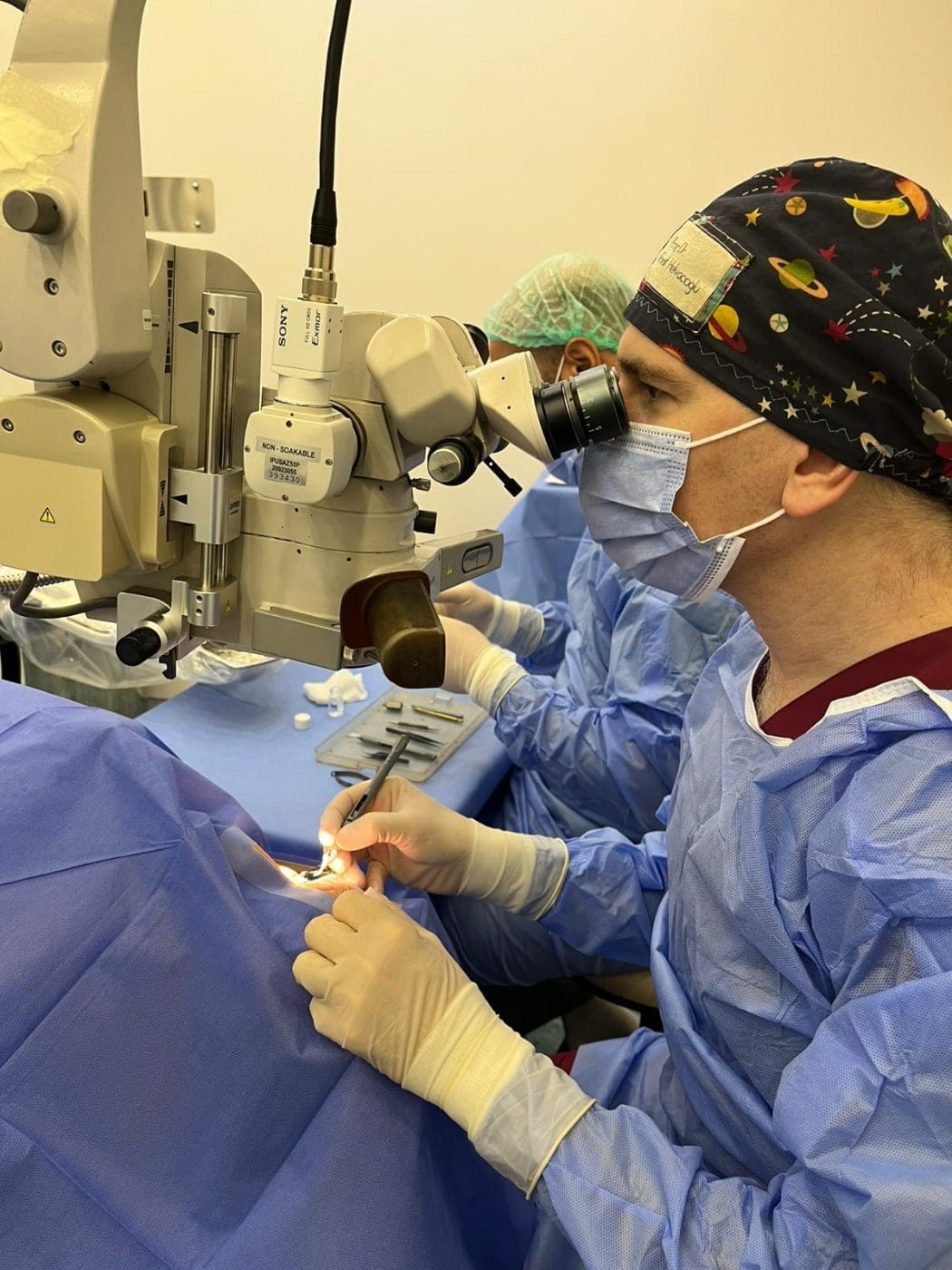
What are intracorneal ring segments (ICRS) and CAIRS?
Intracorneal ring segments (ICRS) are small arc-shaped segments that the surgeon places in a thin tunnel within the cornea; they flatten the cone, regularise the shape of the cornea and improve vision. Conventional rings, however, consist of a synthetic material (PMMA).
CAIRS (Corneal Allogenic Intrastromal Ring Segments) is a different treatment, but it works on the same principle: the segments come from donated human corneal tissue instead of synthetic material. Since they come from tissue, they are more compatible with the cornea, and the surgeon can customise their thickness and length to the patient.
How do intracorneal ring segments work in keratoconus?
Ring segments implanted within the cornea flatten the cone-shaped cornea.
- KeratoconusThe cornea thins and steepens forward into a cone; vision becomes blurred and astigmatism increases.
- Ring segmentsThe surgeon places two small arc-shaped segments within the cornea around the pupil.
- The flattened corneaThe segments flatten the central cornea, making its shape more regular.
Who are they suitable for?
- Moderate keratoconus: Patients who cannot see adequately with glasses and cannot tolerate contact lenses.
- Clear central cornea: Eyes without significant corneal scarring.
- Ectasia after laser surgery: Patients whose cornea has weakened after LASIK.
- Patients wishing to postpone a corneal transplant: In suitable patients, ring segments can delay or eliminate the need for a transplant.
Ring treatment alone does not halt the progression of keratoconus; therefore, in progressive cases we usually plan it together with or after cross-linking.
What happens during the procedure?
- Planning: We determine the number, thickness, length and position of the rings based on corneal tomography.
- Tunnel: Under topical anaesthesia, the surgeon creates a thin tunnel within the cornea with a femtosecond laser or special mechanical dissection instruments.
- Insertion: The surgeon inserts the ring segments into the tunnel; stitches are usually not needed.
- CXL if needed: In progressive cases, the surgeon performs cross-linking in the same or a separate session.
The procedure takes about 15–30 minutes per eye, and the patient goes home the same day.
How do surgeons implant intracorneal ring segments? Step-by-step illustration
From planning to insertion; the same basic steps for synthetic (PMMA) rings and CAIRS.
- PlanningWe determine the number, thickness, length and position of the rings based on corneal tomography.
- Creating the tunnelUnder topical anaesthesia, the surgeon creates a thin tunnel within the cornea with a femtosecond laser or special mechanical instruments.
- Inserting the ringThe surgeon inserts the ring segments into the tunnel; stitches are usually not needed.
- CXL if neededIf the disease is progressing, the surgeon performs cross-linking in the same or a separate session.
CAIRS or synthetic rings?
| Feature | Synthetic ring (ICRS) | CAIRS |
|---|---|---|
| Material | PMMA (plastic) | Donated human corneal tissue |
| Customisation | Standard sizes | The surgeon can tailor thickness and length to the patient |
| Tissue compatibility | Extrusion of the ring or thinning of the surrounding tissue may rarely occur | Better compatibility because it comes from tissue; tissue reactions are rare, but doctors have reported them in special situations such as severe atopy |
| Outcomes | Extensive experience over many years | Improvement similar to synthetic rings in matched comparisons |
Prof. Dr. Fırat Helvacıoğlu’s experience with intracorneal ring segments
Surgeon’s experience and publications
Prof. Dr. Fırat Helvacıoğlu is a co-author of two clinical studies on intracorneal ring segment treatment. In 30 keratoconic eyes, the surgeons implanted the rings with a special mechanical dissection technique; at 1 year, the mean spherical equivalent decreased from −6.42 D to −1.26 D and mean corneal steepness from 49.4 D to 44.4 D, with no serious complications. A study of 12 eyes with post-LASIK ectasia likewise reported significant improvement.
Recovery and outcomes
Mild grittiness and watering may occur in the first days after ring treatment; most patients return to daily life within a few days. However, vision improves over the following weeks, and the corneal shape may take a few months to stabilise fully. Also, in some patients, glasses, soft lenses or a contact lens that now fits more comfortably improve vision further after ring implantation.
Cost and international patients: We determine the cost after the examination. In addition, international patients can send their corneal tomography via WhatsApp for a preliminary assessment; we recommend planning a stay of about one week in Istanbul.
Related treatments: Cross-linking (CXL) · Combined CXL + No Touch · Keratoconus treatment
Frequently asked questions
Yes. If necessary, the surgeon can remove the ring segments or change their position and size; the cornea usually returns close to its previous shape.
Because the ring sits in the deep layers of the cornea, you cannot feel it, and it is usually not noticeable from the outside.
CAIRS segments come from eye bank tissue that has undergone standard testing; surgeons use the same tissue in corneal transplantation. Because the tissue remains within the cornea, the risk of rejection is very low compared with a conventional transplant.
No. Ring segments correct the shape of the cornea and improve vision, but they do not halt progression. In progressive disease, we combine them with cross-linking.
Yes. Because the ring flattens the cornea, lenses fit more comfortably, and many patients tolerate them better.
References
- Tunc Z, Helvacioglu F, Sencan S. Evaluation of intrastromal corneal ring segments for treatment of keratoconus with a mechanical implantation technique. Indian J Ophthalmol. 2013;61(5):218–225. doi:10.4103/0301-4738.109519
- Tunc Z, Helvacioglu F, Sencan S. Evaluation of intrastromal corneal ring segments for treatment of post-LASIK ectasia patients with a mechanical implantation technique. Indian J Ophthalmol. 2011;59(6):437–443. doi:10.4103/0301-4738.86310
- Jacob S et al. Corneal allogeneic intrastromal ring segments for keratoconus – recent evidence and the move to customized shapes. Curr Opin Ophthalmol. 2026;37:289–298. doi:10.1097/ICU.0000000000001237
- Asfar KE et al. Corneal allogenic intrastromal ring segments (CAIRS) versus synthetic segments: a single segment comparative analysis. J Refract Surg. 2024;40:e863–e876. doi:10.3928/1081597X-20241002-02
- Awwad ST et al. Anterior stromal melt with corneal allogeneic intrastromal ring segments in a patient with severe atopy. Cornea. 2025;44:1182–1186. doi:10.1097/ICO.0000000000003851
- Gomes JA et al. Global consensus on keratoconus and ectatic diseases. Cornea. 2015;34(4):359–369. doi:10.1097/ICO.0000000000000408
This page provides patient information and does not replace an examination or medical assessment. We determine the right treatment for you after an eye examination and measurements.
Book a corneal ring segment / CAIRS assessment
Prof. Dr. Fırat Helvacıoğlu · Veni Vidi Eye Clinic, Bağdat Caddesi No: 257, Caddebostan – Kadıköy, Istanbul, Türkiye