Q-LASIK Laser Eye Treatment
LASIK with quick visual recovery · Prof. Dr. Fırat Helvacıoğlu, FEBOS-CR · Veni Vidi Eye Clinic, Caddebostan – Kadıköy, Istanbul
Q-LASIK is a LASIK procedure in which the Med-Logics ML7 LASIK system creates the corneal flap in about 7 seconds with low suction. Because very little corneal oedema develops and the temporal incision reduces dry eye symptoms, vision recovers quickly (quick visual recovery): in most patients it clears within 5–6 hours. It corrects myopia, hyperopia and astigmatism.
What is Q-LASIK?
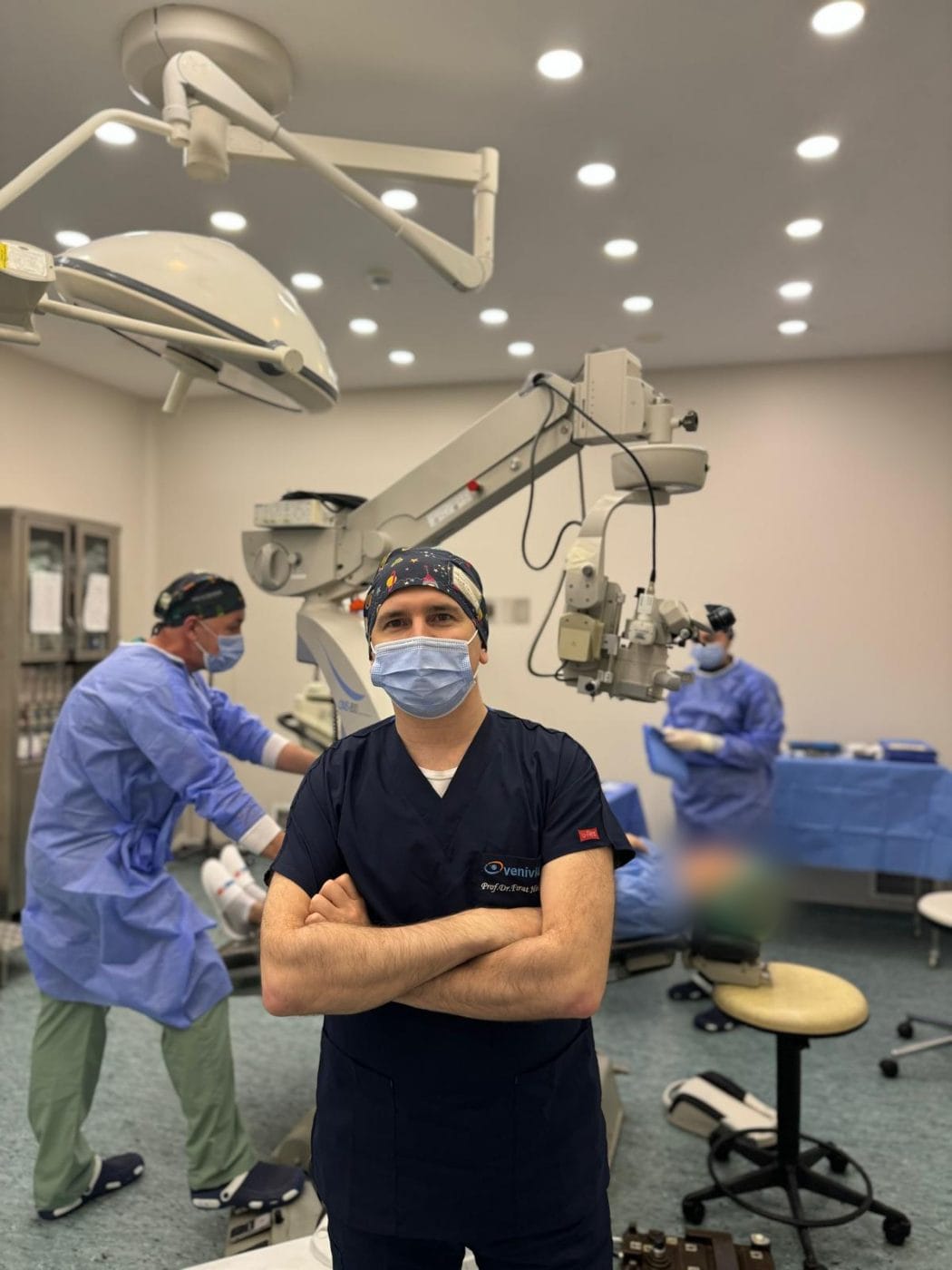
Q-LASIK is a LASIK procedure in which the Med-Logics ML7 LASIK system creates the thin corneal flap, aiming for very rapid visual recovery (quick visual recovery). The “Q” in its name refers to this rapid recovery: in most patients vision reaches 80–90% immediately after surgery and clears within 5–6 hours.
Q-LASIK differs from other LASIK procedures not in the excimer laser it uses but in the way it creates the flap. The ML7 LASIK system creates the flap in about 7 seconds with low suction, so much less oedema (swelling) develops in the cornea. The surgeon can hinge the flap temporally, nasally or superiorly. A temporal incision affects the nerves supplying the cornea less and therefore helps reduce dry eye symptoms after surgery. Minimal oedema and a preserved corneal surface allow vision to clear quickly.
The secret of rapid recovery: the ML7 LASIK system
- A flap in 7 seconds: The ML7 LASIK system creates the flap in about 7 seconds, including suction time; the procedure applied to the eye is very short.
- Low suction: The procedure uses a low suction of about 550 mmHg, reducing pressure on the eye and discomfort.
- Less oedema: Thanks to the short, low-suction procedure, corneal swelling stays minimal and vision clears within hours.
- Flap orientation options: The surgeon can hinge the flap temporally, nasally or superiorly and chooses the most suitable orientation according to the structure of the eye.
- Reduced dry eye: A temporal incision helps preserve the corneal nerves, which reduces dry eye symptoms after surgery.
- Precise, planar cut: The deviation between planned and achieved flap thickness is very low (about ±5 microns).
After creating the flap, the surgeon then corrects the prescription with the excimer laser according to a personalised plan.
How does Q-LASIK work?
- Anaesthesia: First, anaesthetic drops numb the eye; you feel no pain during surgery.
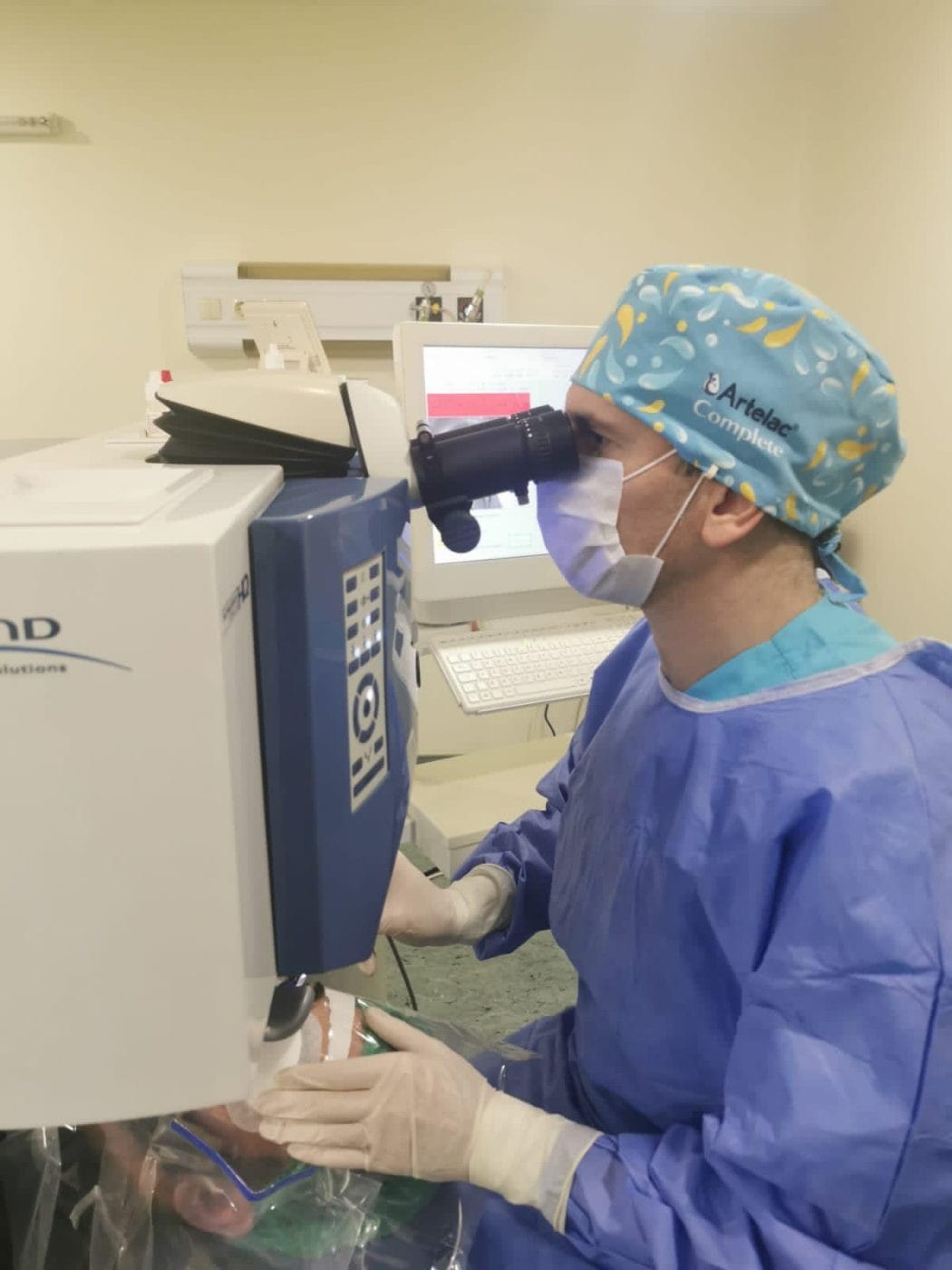
- Flap: The ML7 LASIK system then creates a thin corneal flap in about 7 seconds with low suction.
- Laser: The surgeon lifts the flap, and the excimer laser corrects the prescription according to the personalised plan.
- Repositioning the flap: Finally, the surgeon lays the flap back in place; it needs no stitches, as it adheres on its own.
The total procedure time for both eyes is about 10–15 minutes; the patient goes home the same day.
Step-by-step illustration of the procedure
A flap created with the ML7 LASIK system, followed by the excimer laser.
- Creating the flapThe ML7 LASIK system creates a thin corneal flap in about 7 seconds with low suction.
- Lifting the flapThe flap is gently lifted on its hinge, exposing the underlying corneal tissue.
- Excimer laserThe excimer laser reshapes the exposed tissue according to the personalised plan, correcting the prescription.
- Repositioning the flapThe flap is laid back in place and adheres without stitches; thanks to minimal oedema, vision clears within 5–6 hours.
Who is Q-LASIK suitable for?
Q-LASIK can correct myopia, hyperopia and astigmatism. It may also be an alternative for some patients with regular corneal topography and borderline corneal thickness, if the planning allows. We do not perform laser surgery in eyes with keratoconus or corneal thinning. Instead, we consider cross-linking or an implantable lens (ICL) for these patients.
- Age: At least 18; the most suitable period is usually between 18 and 40.
- Stable prescription: Your prescription should not have changed significantly (by more than 0.5 dioptres) in the past year.
- Healthy cornea: Corneal mapping (topography/tomography) and thickness measurements must be normal, and the tests must rule out keratoconus.
- General health: We do not perform surgery during pregnancy or breastfeeding, and we carefully assess uncontrolled diabetes and certain rheumatic and immune disorders.
- Eye health: We treat significant dry eye, blepharitis or intraocular disease first.
Recovery after Q-LASIK
| Time | What to expect |
|---|---|
| Immediately after surgery | Vision is at 80–90%; watering and light sensitivity are normal |
| 5–6 hours | Vision clears markedly |
| Next day | First check-up; most patients return to daily life |
| Week 1 – month 1 | Check-ups; do not rub the eye and use your drops regularly |
Safe planning and possible side effects
The most important safety consideration in laser treatment is the risk of ectasia — weakening and bulging of the cornea. For this reason, we evaluate corneal topography, tomography, the thickness map and the percent tissue altered (PTA) together before surgery. The PTA shows how much of the cornea the treatment will change. In one case-control study, researchers examined 30 eyes that developed ectasia after LASIK despite normal topography. In 97% of these eyes, the PTA was 40% or more (Santhiago et al., Am J Ophthalmol 2014).
AI-assisted planning
Prof. Dr. Fırat Helvacıoğlu is a member of the Medical Advisory Board of RLES AI, a clinical decision support platform that analyses topography, tomography, pachymetry and other measurements across about 300 parameters. However, the surgical decision always rests with the surgeon; the decision support system helps ensure a complete check of the measurements.
Possible side effects: Temporary dry eye, glare or halos around headlights at night in the first months, and light sensitivity are common and mostly temporary. On the other hand, flap-related problems, infection, deviation from the target refraction and corneal ectasia are rare complications.
A Cochrane review comparing LASIK with a mechanically created flap and LASIK with a femtosecond laser–created flap found no difference in visual outcomes; diffuse lamellar keratitis (DLK) was less common with the mechanical method. Regarding hinge position, a randomised microkeratome study showed better preservation of corneal sensation and milder dry eye signs with horizontally positioned hinges, whereas some femtosecond laser studies have reported no significant difference related to hinge position.
Q-LASIK, No Touch or SMILE Pro?
In eyes with suitable corneal thickness and structure, Q-LASIK is one of the methods with the fastest visual recovery and least pain. For contact sports or thin corneas, No Touch may be preferable, and for myopic patients prone to dry eye, SMILE Pro. Examination and measurements determine which method is right for you.
Q-LASIK cost and information for international patients
We determine the cost after the examination. Laser vision correction is an elective procedure, and health insurance generally does not cover it. For international patients: thanks to the rapid visual recovery, we can usually complete the assessment, surgery and next-day check within about 3 days in Istanbul. Consultations are also available in English.
Other methods: SMILE Pro · No Touch · Femto-LASIK · All laser methods
Frequently asked questions
“Q” stands for quick visual recovery. Because the ML7 LASIK system creates the flap in 7 seconds with low suction, very little corneal oedema develops. As a result, in most patients vision is at 80–90% immediately after surgery and clears within 5–6 hours.
The difference lies not in the excimer laser used but in the way Q-LASIK creates the flap. The ML7 LASIK system can create the flap very quickly, with low suction, hinged temporally, nasally or superiorly. As a result, less corneal oedema develops, a temporal incision reduces dry eye symptoms and vision clears faster.
The total procedure time for both eyes is about 10–15 minutes. Creating the flap takes about 7 seconds, and the laser application lasts a matter of seconds.
We perform the operation under topical anaesthesia, and you feel no pain. Watering, burning and light sensitivity may occur for a few hours afterwards; grittiness and watering are much less than after surface treatments.
Vision clears within 5–6 hours; most patients can return to daily life and desk work the next day after their check-up.
If corneal topography is regular, Q-LASIK may be suitable for some patients with borderline corneal thickness. We make the decision by evaluating corneal thickness, tomography and the percent tissue altered (PTA) together. If it is not suitable, we may recommend No Touch or an implantable lens.
In eyes with suitable corneal structure, Q-LASIK offers faster and more comfortable recovery. However, for thin corneas, contact sports or occupations with a risk of trauma, No Touch may be preferable.
No. Keratoconus is a contraindication to laser treatment. Instead, in these patients, cross-linking halts disease progression; for vision, we consider special contact lenses or, in suitable patients, an implantable lens (ICL).
In correctly selected patients with a stable prescription, the result is largely permanent. However, difficulty with near vision that appears in the 40s (presbyopia) is a separate, age-related condition.
References
- Kahuam-López N et al. Laser-assisted in-situ keratomileusis (LASIK) with a mechanical microkeratome compared to LASIK with a femtosecond laser for LASIK in adults with myopia or myopic astigmatism. Cochrane Database Syst Rev. 2020;4(4):CD012946. doi:10.1002/14651858.CD012946.pub2
- Donnenfeld ED et al. The effect of hinge position on corneal sensation and dry eye after LASIK. Ophthalmology. 2003;110(5):1023–1029. doi:10.1016/S0161-6420(03)00100-3
- Mian SI et al. Dry eyes and corneal sensation after laser in situ keratomileusis with femtosecond laser flap creation: effect of hinge position, hinge angle, and flap thickness. J Cataract Refract Surg. 2009;35(12):2092–2098. doi:10.1016/j.jcrs.2009.07.009
- Santhiago MR et al. Association between the percent tissue altered and post-laser in situ keratomileusis ectasia in eyes with normal preoperative topography. Am J Ophthalmol. 2014;158(1):87–95. doi:10.1016/j.ajo.2014.04.002
- Eydelman M et al. Symptoms and satisfaction of patients in the Patient-Reported Outcomes With Laser In Situ Keratomileusis (PROWL) studies. JAMA Ophthalmol. 2017;135(1):13–22. doi:10.1001/jamaophthalmol.2016.4587
- Shortt AJ, Allan BD, Evans JR. Laser-assisted in-situ keratomileusis (LASIK) versus photorefractive keratectomy (PRK) for myopia. Cochrane Database Syst Rev. 2013;(1):CD005135. doi:10.1002/14651858.CD005135.pub3
This page is intended for patient information and does not replace an examination or medical assessment. The treatment that is right for you is determined after an eye examination and measurements.
Book a Q-LASIK suitability assessment
Prof. Dr. Fırat Helvacıoğlu · Veni Vidi Eye Clinic, Bağdat Caddesi No: 257, Caddebostan – Kadıköy, Istanbul, Türkiye